

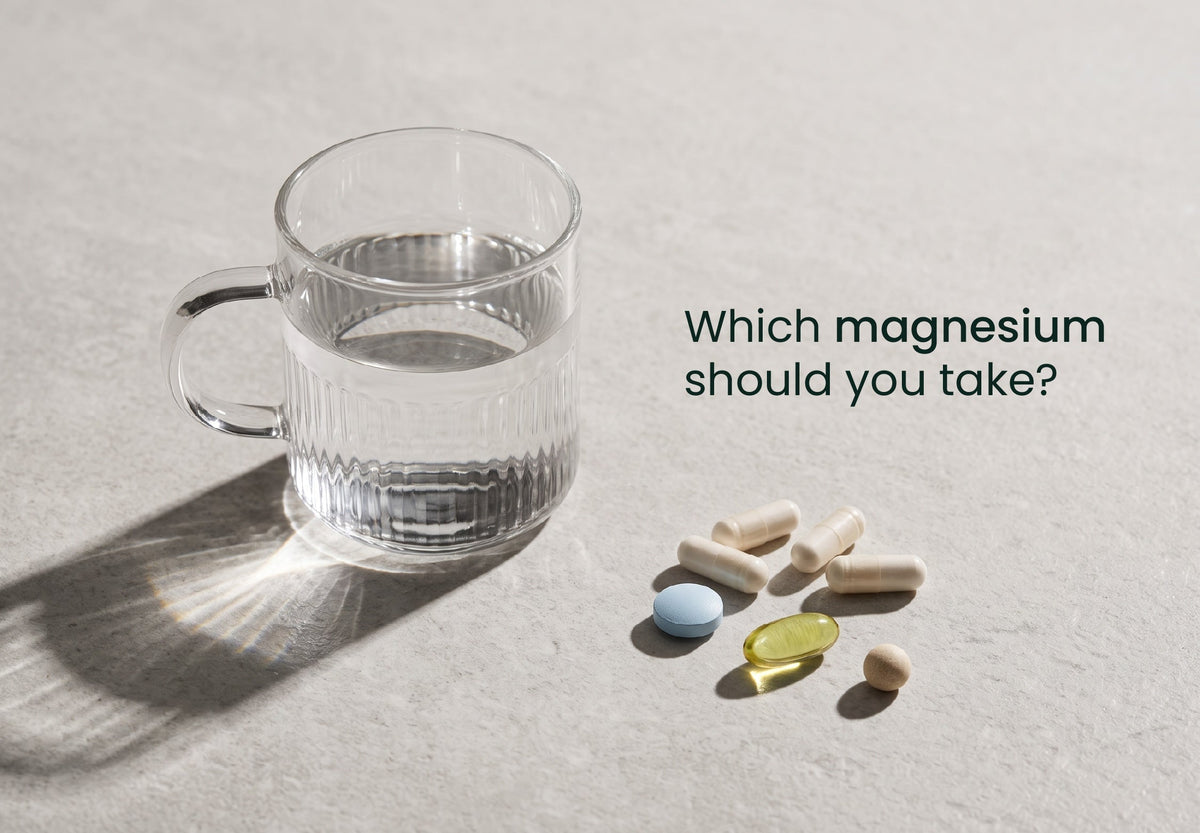
Which magnesium should you take?
First, what "inorganic" even means
The word sounds like a warning, but it’s just chemistry. Magnesium never comes on its own. It’s always paired with a partner, and that partner is the name on the label. Oxide, citrate, glycinate, those are all just magnesium plus whoever it showed up with.
The Three Inorganic Forms
-
Oxide, the one to skip. This is the clingiest partner of all. Oxide barely dissolves, so most of the magnesium never breaks free to be absorbed. One often-cited study measured it at about four percent,¹ and in a two-month trial it lifted people’s magnesium no more than a sugar pill did.² Worse, all that un-absorbed magnesium sitting in your gut pulls water in behind it, which is the exact way a laxative works. That’s why oxide is sold for constipation.⁴ It’s cheap and loaded with magnesium on paper, but very little of it ever reaches you.
-
Sulfate, the bath one. You might already have this in the cupboard: it’s Epsom salt. Taken by mouth it pulls water into the gut fast, so it’s sold as a saline laxative⁵ and a soak for sore muscles, not as something you take daily. Fine for the occasional need, wrong tool for keeping your magnesium topped up.
-
Chloride, the fair surprise. Here’s where the “inorganic is bad” rule falls apart. Chloride is inorganic, but it’s an easygoing partner, it dissolves and absorbs about as well as the pricier organic forms.¹ It’s proof the problem was never “inorganic.” It was oxide, specifically.
The Forms Worth Reaching For
Past the inorganic aisle, you get to the forms most people are after. These are the organic magnesiums, where the partner is something friendlier, usually an amino acid or an acid your body knows from food. Citrate, glycinate, malate, and a few cousins.
Where that Leaves You
So the shelf is less of a maze than it looks. The next time you’re standing in front of it, you can skip the spiral of comparing eight labels. Avoid the one that barely absorbs, pick a good one that sits well with you, and let consistency do the rest. That’s the whole game.
References
-
Firoz M, Graber M. Bioavailability of US commercial magnesium preparations. Magnes Res. 2001;14(4):257-262.
-
Walker AF, Marakis G, Christie S, Byng M. Mg citrate found more bioavailable than other Mg preparations in a randomised, double-blind study. Magnes Res. 2003;16(3):183-191.
-
Schuchardt JP, Hahn A. Intestinal absorption and factors influencing bioavailability of magnesium — an update. Curr Nutr Food Sci. 2017;13(4):260-278. doi:10.2174/1573401313666170427162740.
-
Mori H, Tack J, Suzuki H. Magnesium oxide in constipation. Nutrients. 2021;13(2):421. doi:10.3390/nu13020421.
-
Dupont C, Hébert G. Magnesium sulfate-rich natural mineral waters in the treatment of functional constipation — a review. Nutrients. 2020;12(7):2052. doi:10.3390/nu12072052.
Quick FAQ
Leer más

It's 1 am and you're still awake, scrolling. Somewhere in that scroll is a video about sleep. A "sleepy girl mocktail," a magnesium powder, a gummy someone swears changed their life. The sleep ais...
Your friend swears by magnesium. A podcast keeps pushing ashwagandha. Both are supposed to help with stress and sleep, both are sitting in your cart, and buying two supplements to fix one problem f...
Dejar un comentario
Todos los comentarios se revisan antes de su publicación.
Este sitio está protegido por hCaptcha y se aplican la Política de privacidad de hCaptcha y los Términos del servicio.