Ir al contenido

Cesta

La cesta está vacía

Seguir comprando

Sign Up & Unlock 15% Off Neumina

Join the Neumina community today! Use code: WELCOME15 at checkout.

Enter your email above to instantly activate your 15% off code for your first purchase.

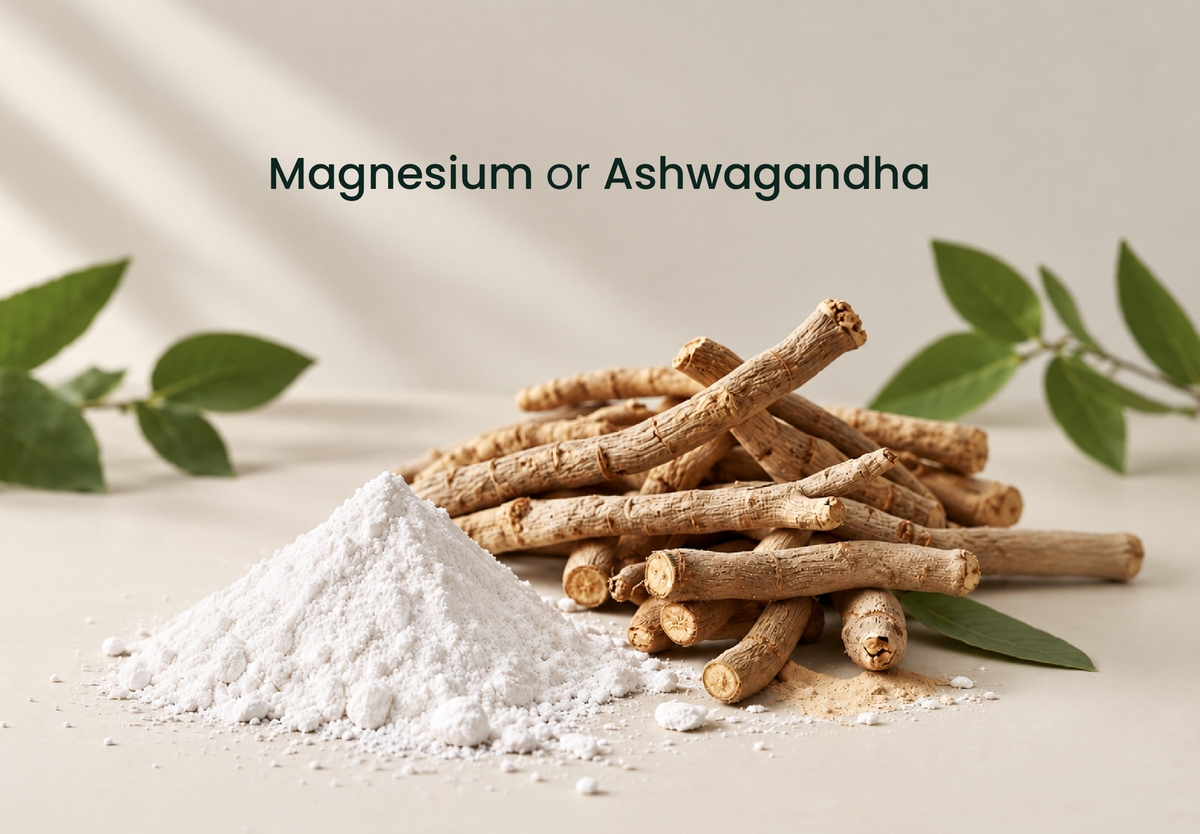
Magnesium or ashwagandha: which one do you actually need?
18 sept 20264 min de lectura

Magnesium or ashwagandha: which one do you actually need?

Your friend swears by magnesium. A podcast keeps pushing ashwagandha. Both are supposed to help with stress and sleep, both are sitting in your cart, and buying two supplements to fix one problem feels like overkill. So you want the honest answer to a simple question. If you’re only going to take one, which one should it be?

They get talked about like rivals, two options competing for the same job. So let’s treat it that way and see which one earns the spot.

First, what each one does

Before we pick a winner, it helps to know what each one does, because they don’t work the same way.


Magnesium helps your body relax now. It calms your muscles⁴ and your nervous system,⁵ so you can fall asleep more easily. You feel it the same night, more or less.

Ashwagandha works on something slower: the stress that builds up over time. It lowers cortisol, the hormone that keeps you wired, but it works slowly, over a few weeks.

So one loosens the tension you’re feeling tonight. The other chips away at where that tension comes from. Different jobs. Which means the real question isn’t which is stronger, it’s which one your problem needs.

The Case for Magnesium

Magnesium is the one to reach for when you want to calm down. It helps relax your muscles and calm your nervous system, so you can fall asleep more easily.


In a review that pooled three trials of older adults, people taking magnesium fell asleep about 17 minutes faster than those on a placebo.¹ It’s a modest effect, and the studies were small, but it’s a real difference in how fast people fell asleep.

It is cheap, gentle, and works the same night instead of making you wait. If what’s keeping you up is mostly physical, magnesium is the simplest place to start.

The Case for Ashwagandha

Ashwagandha is the one to reach for when the problem is bigger than one bad night. It works on cortisol, the stress hormone that stays high when you’re under pressure for a long time.


Give it time and it helps you sleep. In a review pooling five trials, people taking ashwagandha fell asleep faster, stayed asleep, and slept longer, and those were the results the studies agreed on most.² It also brought cortisol down.³ The catch is that it’s slow. It works best at higher doses taken for about two months, not overnight.

One honest note. Ashwagandha lowered cortisol, but in the same research people didn’t report feeling less stressed.³ So it’s better seen as help for your sleep, not a way to feel calmer.

Which One Wins?

That’s the wrong question.


Look again at what they do. Magnesium calms your body tonight. Ashwagandha lowers the stress hormone over weeks. Those aren’t two answers to the same problem. They’re answers to two different halves of it. One handles the tension you feel right now, the other works on the pressure underneath it.

Which is why the best answer usually isn’t one or the other. It’s both. They work on separate systems, so putting them together covers more ground than either can alone. And because they don’t act on the same pathway, they don’t get in each other’s way. There’s no known conflict between them, and they’re commonly taken side by side.

That’s the honest reason the two so often come paired in the same product. Not a gimmick, but two different tools for two different parts of the same restless night.

What Should I Choose?

If you only want one, let your main problem pick. When it’s your body that won’t calm down at night, start with magnesium. When it’s weeks of built-up stress and rough sleep, reach for ashwagandha, and give it time. And if it’s both, which for a lot of people it is, there’s no reason not to take both.


That’s the honest answer this question rarely gets. Not a winner and a loser, but two tools for two different problems, and a good chance you’ll want them both.

One practical note. Both are widely used and generally well tolerated, but supplements aren’t right for everyone. If you take medication or have any health conditions, check with your doctor before starting.


Curious how we combine them? Take a look at our Triple Magnesium Complex & Ashwagandha.

*These statements have not been evaluated by the Food and Drug Administration. This product is not intended to diagnose, treat, cure, or prevent any disease.


References

  1. Mah J, Pitre T. Oral magnesium supplementation for insomnia in older adults: a systematic review and meta-analysis. BMC Complement Med Ther. 2021;21(1):125. doi:10.1186/s12906-021-03297-z.
  2. Cheah KL, Norhayati MN, Husniati Yaacob L, Abdul Rahman R. Effect of ashwagandha (Withania somnifera) extract on sleep: a systematic review and meta-analysis. PLoS One. 2021;16(9):e0257843. doi:10.1371/journal.pone.0257843.
  3. Albalawi AA. Dual impact of ashwagandha: significant cortisol reduction but no effects on perceived stress, a systematic review and meta-analysis. Nutr Health. 2025;31(4):1395-1408. doi:10.1177/02601060251363647.
  4. Liguori S, Moretti A, Paoletta M, Gimigliano F, Iolascon G. Role of magnesium in skeletal muscle health and neuromuscular diseases: a scoping review. Int J Mol Sci. 2024;25(20):11220. doi:10.3390/ijms252011220.
  5. Kirkland AE, Sarlo GL, Holton KF. The role of magnesium in neurological disorders. Nutrients. 2018;10(6):730. doi:10.3390/nu10060730.
Compartir

Dejar un comentario

Todos los comentarios se revisan antes de su publicación.

Este sitio está protegido por hCaptcha y se aplican la Política de privacidad de hCaptcha y los Términos del servicio.

Quick FAQ

Amy Qin, PhD, RD, CDCES, Nutrition Scientist at Neumina

Amy Qin is a Nutrition Scientist at Neumina with training in both nutrition research and clinical care. She received her PhD in Nutrition and Metabolism from the University of Wisconsin-Madison and completed clinical training at Stanford Hospital and UCSF Benioff Children's Hospital.

Her work focuses on applying nutrition science to metabolism, aging, and chronic disease management in ways that are practical and personalized.