

Your Gut Is Doing More Than You Think
Written by: Jose Guizar Real, MSc
Reviewed by: Yiming (Amy) Qin, PhD, RD
Your digestion gets a lot of credit, and a lot of blame. Bloating after a meal? Gut's fault. Irregular digestion? Gut again. But here's the part most people miss: your gut is involved in systems that have nothing to do with digestion at all.
Meet Your Microbiome
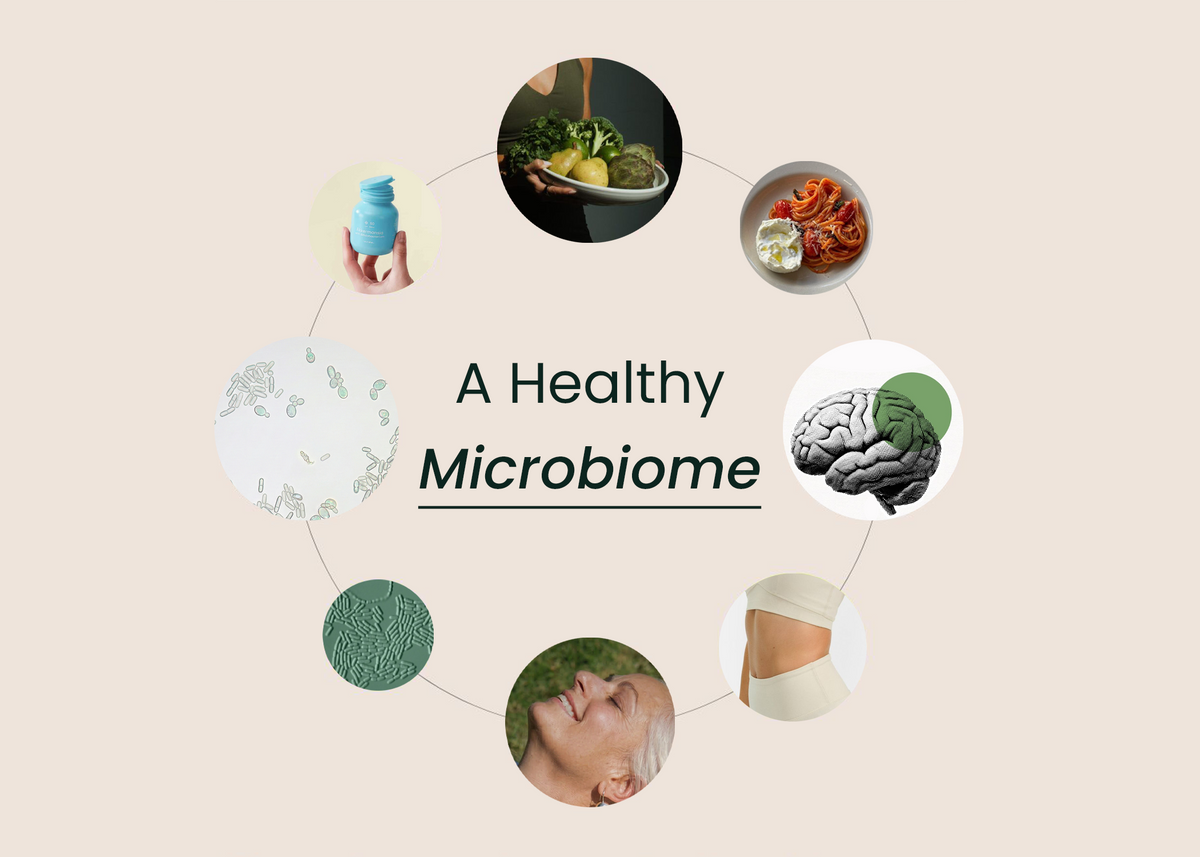
Think of the gut like a city. Some residents are builders: producing vitamins, fueling the gut lining, communicating with the immune system, and sending signals to the brain. Others are opportunists, quiet when conditions are good and disruptive when they're not. The city only functions well when the builders outnumber the opportunists.
That balance is your microbiome. And it influences almost everything your body does.
When the builders thrive, they produce short-chain fatty acids that fuel the cells lining your gut wall, support immune regulation, and influence neurotransmitters (including serotonin and GABA) that drive the gut-brain communication affecting mood, focus, and sleep.²·³ When the opportunists gain ground, the whole system shifts. Not just digestion. Everything goes downstream.
When that balance moves in the wrong direction, scientists call it dysbiosis: a shift in the microbial community that works against the body rather than with it. It is one of the most common and least recognized contributors to how people feel day to day.
For a deeper look at what a healthy microbiome does and what happens when balance is lost:
The Gut Lining: The Wall Nobody Talks About
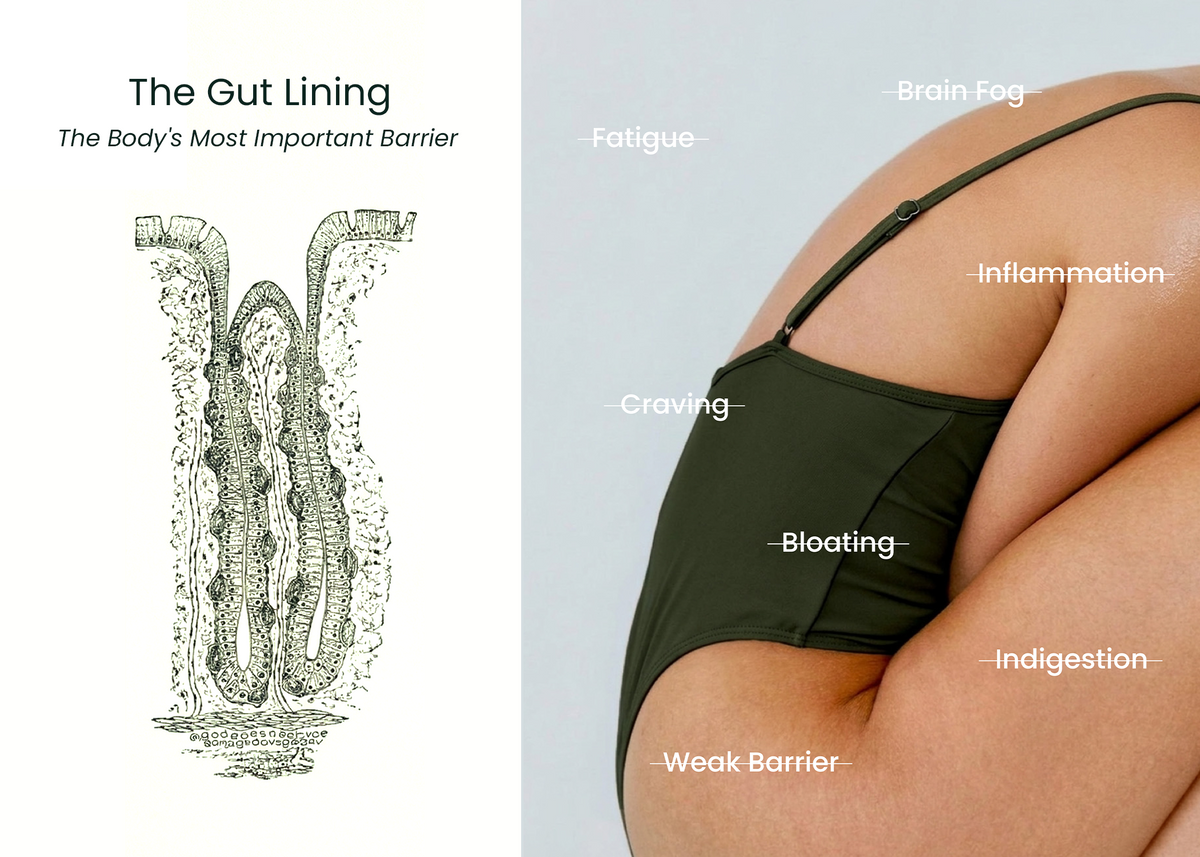
Running the length of your digestive tract is a barrier so thin it would cover the floor of a studio apartment if laid flat, yet it is one of the most structurally important systems in your body.⁴
This is the gut lining. Its job is simple: nutrients in, everything else out. When it is intact and well-supported, it does this quietly and effectively. When it is compromised by poor diet, chronic stress, disrupted sleep, or certain medications, substances that should remain in the gut can pass into circulation. The immune system responds. A background level of inflammation follows. And the effects appear in places that seem entirely unrelated to digestion.
Skin that flares. Energy that crashes. Mood that shifts without explanation. Immunity that feels unreliable.
The gut lining is not glamorous. But supporting it may be the single most overlooked thing most people could do for how they feel day to day.
For a deeper look at how the gut lining works and what compromises it:
What Disrupts the Balance
The gut microbiome is resilient, but not invincible. Several well-documented factors shift the balance from builders to opportunists, sometimes quickly:
-
Diet: Processed foods, added sugars, and low-fiber diets reduce microbial diversity, which is the variety that makes the ecosystem resilient. Research involving over 10,000 participants found that people who ate more than 30 different plant foods per week had significantly more diverse microbiomes than those who ate fewer than 10.⁵
-
Stress: Chronically elevated cortisol has been associated with reduced microbial diversity and direct compromise of the gut lining, with the gut-stress relationship running in both directions.⁶
-
Sleep: Even short-term sleep disruption can alter gut microbiome composition measurably. In one study, two nights of partial sleep deprivation were enough to produce detectable shifts in microbial populations.⁷
-
Antibiotics: A single course can alter microbial composition for months, and in some individuals, years.⁸·⁹ Not a reason to avoid them when medically necessary, but a reason to be thoughtful about rebuilding afterward.
What Actually Supports It
The most consistent finding in gut health research is not about any single supplement or superfood. It is about diversity: in the microbiome itself, and in the approaches used to support it.
Variety in plant foods
Prebiotic fiber
Consistency
Where to Start
Supporting gut health does not require an overhaul. The research points to a few high-leverage habits that show up consistently across studies:
-
Aim for variety, not volume. Thirty different plant foods per week (herbs, spices, legumes, and different-colored vegetables all count) is one of the most documented ways to increase microbiome diversity.
-
Include at least one prebiotic food daily. Garlic, onions, leeks, oats, and bananas are among the most accessible sources of the fiber that selectively feeds beneficial bacteria.
-
Protect your sleep. Measurable microbiome changes can occur within 48 hours of disrupted sleep. Consistent sleep timing supports gut health as directly as most dietary changes.
-
Reduce ultra-processed food where realistic. Not as a rule, but because the emulsifiers and low fiber content common in these foods have been associated with disruption of the mucus layer and reduction in microbial diversity.¹¹
The Gut-Brain Connection: A Two-Way Street
Most people know the brain sends signals to the gut. What most people don't know is that the gut sends signals back, and research suggests the majority of communication along the vagus nerve travels upward, from gut to brain, rather than downward.¹²
The Bottom Line
The gut is not just a digestive organ. It is an ecosystem: complex, dynamic, and deeply connected to almost every system in your body.
When it is balanced, most people don't notice. When it isn't, the effects ripple outward in ways that rarely get traced back to their source.
Supporting gut health is not about one miracle ingredient or one perfect diet. It is about understanding what the ecosystem needs: diversity, consistency, the right inputs, and the time to respond, and giving it those things as regularly as possible.
Because almost everything starts here.
Frequently Asked Questions
What is the gut microbiome?
The gut microbiome is the community of approximately 38 trillion microorganisms (bacteria, fungi, viruses, and others) living in the digestive tract. These microorganisms actively produce vitamins, regulate immune responses, maintain the gut lining, and influence neurotransmitter production. They are not passengers. They are participants in nearly every system in the body.
How do I know if my gut health needs attention?
There is no single test that definitively answers this. Common signs associated with microbial imbalance include persistent digestive discomfort, low energy, frequent bloating, skin concerns, and mood variability, though these can have many causes. If concerns are persistent, speaking with a healthcare provider is the appropriate first step.
Do I need supplements to support my gut?
Not necessarily. The strongest evidence for gut health points to dietary diversity and lifestyle consistency before any supplement. Where supplementation can play a role (through prebiotic fibers, specific probiotic strains, or targeted nutrients) are most effective when working alongside a varied diet rather than alone.
References
-
Sender R, Fuchs S, Milo R. Revised estimates for the number of human and bacteria cells in the body. PLoS Biol. 2016;14(8):e1002533. doi:10.1371/journal.pbio.1002533
-
Yano JM, Yu K, Donaldson GP, et al. Indigenous bacteria from the gut microbiota regulate host serotonin biosynthesis. Cell. 2015;161(2):264-276. doi:10.1016/j.cell.2015.02.047
-
Bravo JA, Forsythe P, Chew MV, et al. Ingestion of Lactobacillus strain regulates emotional behavior and central GABA receptor expression in a mouse via the vagus nerve. Proc Natl Acad Sci USA. 2011;108(38):16050-16055. doi:10.1073/pnas.1102999108
-
Helander HF, Fändriks L. Surface area of the digestive tract — revisited. Scand J Gastroenterol. 2014;49(6):681-689. doi:10.3109/00365521.2014.898326
-
McDonald D, Hyde E, Debelius JW, et al. American Gut: an open platform for citizen science microbiome research. mSystems. 2018;3(3):e00031-18. doi:10.1128/mSystems.00031-18
-
Karl JP, Margolis LM, Madslien EH, et al. Changes in intestinal microbiota composition and metabolism coincide with increased intestinal permeability in young adults under prolonged physiological stress. Am J Physiol Gastrointest Liver Physiol. 2017;312(6):G559-G571. doi:10.1152/ajpgi.00066.2017
-
Benedict C, Vogel H, Jonas W, et al. Gut microbiota and glucometabolic alterations in response to recurrent partial sleep deprivation in normal-weight young individuals. Mol Metab. 2016;5(12):1175-1186. doi:10.1016/j.molmet.2016.10.003
-
Jernberg C, Löfmark S, Edlund C, Jansson JK. Long-term ecological impacts of antibiotic administration on the human intestinal microbiota. ISME J. 2007;1(1):56-66. doi:10.1038/ismej.2007.3
-
Dethlefsen L, Relman DA. Incomplete recovery and individualized responses of the human distal gut microbiota to repeated antibiotic perturbation. Proc Natl Acad Sci USA. 2011;108(suppl 1):4554-4561. doi:10.1073/pnas.1000087107
-
Deehan EC, Yang C, Perez-Muñoz ME, et al. Precision microbiome modulation with discrete dietary fiber structures directs short-chain fatty acid production. Cell Host Microbe. 2020;27(3):389-404. doi:10.1016/j.chom.2020.01.006
-
Chassaing B, Koren O, Goodrich JK, et al. Dietary emulsifiers impact the mouse gut microbiota promoting colitis and metabolic syndrome. Nature. 2015;519(7541):92-96. doi:10.1038/nature14232
-
Bonaz B, Bazin T, Pellissier S. The vagus nerve at the interface of the microbiota-gut-brain axis. Front Neurosci. 2018;12:49. doi:10.3389/fnins.2018.00049
Quick FAQ
Leer más
Discover the delicate balance of your gut microbiome and the hidden mechanisms behind dysbiosis. This comprehensive guide explores how modern lifestyle factors—like low-fiber diets, stress, and ant...

Magnesium is the invisible engine behind your energy, sleep, and muscle recovery. This comprehensive guide reveals why standard blood tests often miss magnesium deficiency, how modern diets and chr...
Dejar un comentario
Todos los comentarios se revisan antes de su publicación.
Este sitio está protegido por hCaptcha y se aplican la Política de privacidad de hCaptcha y los Términos del servicio.