



Akkermansia Muciniphila: The Specialist in the Wall
Written by: Jose Guizar Real, MSc
Reviewed by: Yiming (Amy) Qin, PhD, RD
Akkermansia muciniphila is a bacterium that lives in the mucus layer of the gut wall, uses mucin as its primary food source, and plays a documented role in maintaining gut lining integrity and supporting metabolic health. First identified in 2004, it accounts for more than 1% of the total bacterial population in a healthy adult gut.¹·² Unlike most gut bacteria, which live in the center of the intestinal tract fermenting fiber and producing metabolites, Akkermansia occupies a specific ecological niche: the mucus layer itself. That unusual address is the key to understanding what it does and why it has become one of the most studied bacteria in microbiome research.
Meet the Bacterium Living in Your Gut Walls
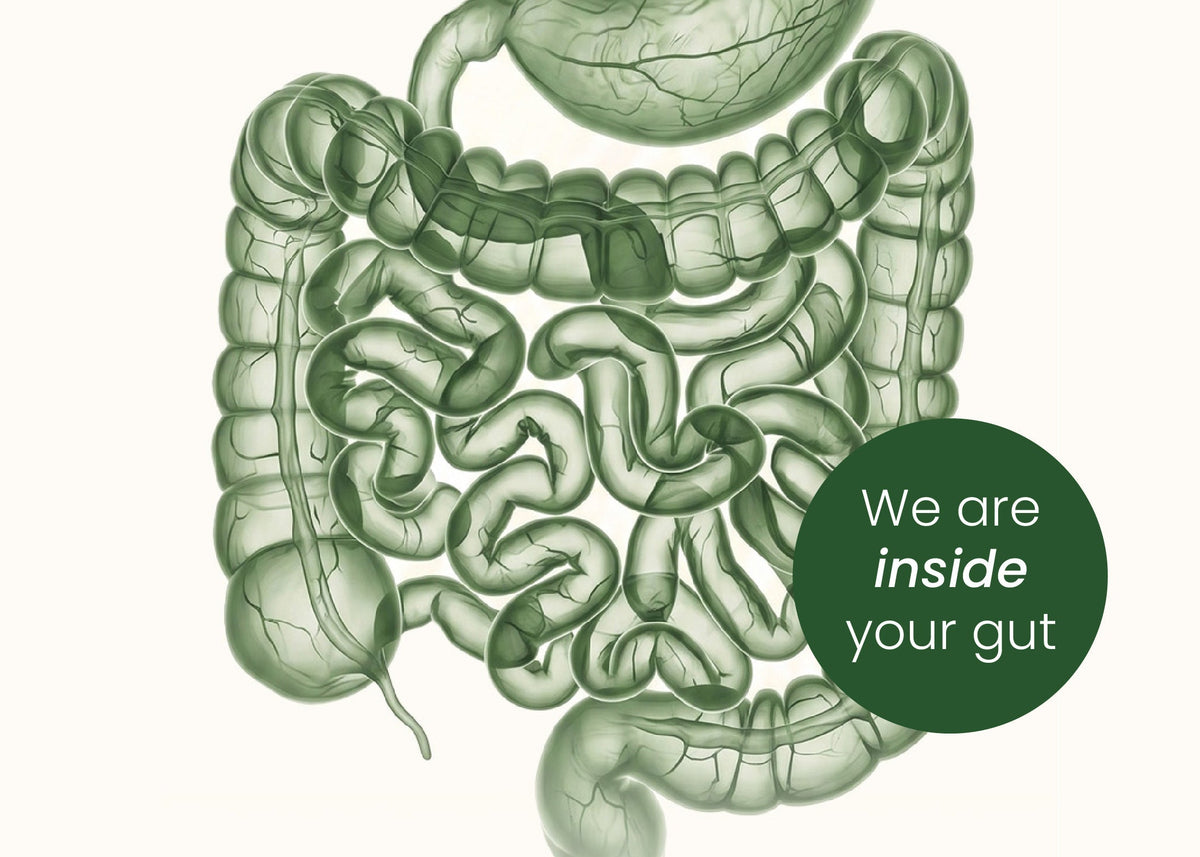
Most bacteria in the gut live in the intestinal contents, floating in the center of the digestive tract. Akkermansia muciniphila does not live there. It lives in the walls.
What Does Akkermansia Actually Do in There
Akkermansia performs three interconnected functions, each tied to its unusual position in the mucus layer.
Mucus layer maintenance
The mucus layer lining the gut is not static. It is constantly being broken down and rebuilt, a continuous renewal cycle that keeps it thick enough to protect the cells beneath. Mucin is the protein that gives this layer its structure, and Akkermansia feeds on it as its primary food source. In doing so it produces short-chain fatty acids that signal the cells responsible for mucus production to keep building.³ Without adequate Akkermansia, this renewal cycle slows down. The mucus layer thins, the protection it provides weakens, and the gut lining beneath becomes more exposed to bacteria and compounds that should have stayed further away.
Gut lining support
Beyond the mucus layer, Akkermansia also influences the cells of the gut lining directly. It produces a specific protein on its outer membrane called Amuc_1100, which interacts with receptors on those cells in a way that supports their integrity. Think of it as a key fitting a lock on the gut lining cells, the layer we cover in detail in [The Gut Lining — The Body's Most Important Barrier]. When that connection happens, it strengthens the seals between cells, helping to keep the lining intact.⁴ A proof-of-concept human trial published in Nature Medicine in 2019 found a 28.62% improvement in insulin sensitivity in adults who supplemented with Akkermansia over three months, alongside reductions in plasma cholesterol and improvements in other metabolic markers.⁶
Metabolic signaling
The gut is not just a digestive organ. It is also a signaling system that communicates with the rest of the body through hormones and chemical messengers. One of those signals is GLP-1, a hormone the gut produces naturally that plays a role in appetite regulation and how the body manages blood sugar.
Who Benefits Most From Akkermansia Support
If you have been eating a low-fiber diet, going through a stressful period, recovering from antibiotics, or sleeping poorly, your Akkermansia levels are likely lower than they should be. Most people with depleted levels do not know it until they start paying attention to what those factors actually do inside the gut. Akkermansia's effects are most pronounced in people with lower baseline levels. Research consistently shows that individuals with higher baseline Akkermansia abundance exhibit healthier metabolic status, and those with lower levels show the greatest improvements in response to dietary interventions.⁷ Restoring those levels has been associated with meaningful improvements in gut lining integrity and metabolic health markers.
What Supports Akkermansia Levels Naturally
Supporting Akkermansia is not just about supplementation. The broader gut environment matters as much as any targeted intervention.
-
Polyphenol-rich foods. Plant compounds found in pomegranate, cranberry, green tea, and dark berries have some of the most consistently documented effects on Akkermansia growth across animal and human research.⁸ These compounds appear to create a gut environment that favors Akkermansia growth and activity.
-
Prebiotic fiber. Found in chicory, garlic, leeks, and onions, prebiotic fiber supports the broader bacterial ecosystem that produces the butyrate Akkermansia depends on.⁹ Supporting Akkermansia is not just about feeding it directly. It is about maintaining the ecosystem it is part of.
-
Intermittent fasting. Periods without food have been associated with increased Akkermansia levels in research, potentially because reduced competition from other bacteria allows Akkermansia's mucin-focused activity to operate more efficiently.¹⁰
-
Managing dysbiosis drivers. A low-fiber diet, chronic stress, antibiotic use, and disrupted sleep all deplete Akkermansia populations.³·¹¹·¹²·¹³ Managing these factors consistently gives Akkermansia the conditions it needs to maintain its presence in the mucus layer.
How Is Akkermansia Prepared For Supplementation
Akkermansia presents a preparation challenge that most probiotic strains do not face. It is unusually sensitive to the conditions encountered during manufacturing, storage, and digestive transit. Standard production methods used for Lactobacillus and Bifidobacterium strains do not translate directly to Akkermansia.
What To Look For In An Akkermansia Supplement
-
Live vs. processed preparations. For the full range of Akkermansia's documented functions, particularly its role in ongoing mucus layer maintenance, live Akkermansia that can colonize the mucus layer is the form most directly supported by the research. Preparations that cannot establish an active presence in the mucus layer cannot replicate the continuous renewal cycle Akkermansia is known for.
-
CFU or AFU count with context. Viable cell counts matter, but they are only meaningful if the preparation method is designed to survive manufacturing and digestive transit. A high CFU count in a poorly stabilized product delivers less than a lower count in a well-prepared one.
-
Fiber and ecosystem support. Because Akkermansia depends on a functioning gut ecosystem, products that pair it with prebiotic fiber or complementary bacterial strains are more likely to reflect the conditions under which the research was conducted. Akkermansia in isolation, without the dietary context that supports it, is only part of the picture.
-
Transparency on sourcing and standardization. Products that declare their strain identity, preparation method, and testing approach are the ones most likely to deliver what is on the label.
Akkermansia muciniphila is one of the most studied bacteria in microbiome research. The mechanism connecting it to gut lining health, metabolic signaling, and inflammatory regulation is well documented across laboratory, animal, and early human research. The human supplementation story continues to develop, with multiple trials now underway.
Frequently Asked Questions
What makes Akkermansia muciniphila different from regular probiotics?
Most probiotic strains, including Lactobacillus and Bifidobacterium species, live in the intestinal contents and ferment dietary sugars and fiber. Akkermansia muciniphila lives specifically in the mucus layer of the gut wall and uses mucin as its primary food source. This gives it a fundamentally different function: maintaining the mucus layer that protects the gut lining, supporting lining integrity, and influencing metabolic signaling pathways including GLP-1 production. It is not simply a more specialized probiotic. It is a functionally distinct organism with a different mechanism and a different research profile.
Who is most likely to benefit from Akkermansia supplementation?
Research consistently shows that Akkermansia levels are depleted by the same factors that drive broader gut dysbiosis: low-fiber diets, processed foods, chronic stress, antibiotic use, and disrupted sleep.³·¹¹·¹²·¹³ People whose gut microbiome diversity has been compromised by these factors tend to show the most meaningful response to Akkermansia support. In people with already healthy and diverse microbiomes, the measurable effects are smaller, though the role Akkermansia plays in maintaining the mucus layer remains important regardless of baseline levels.
Does Akkermansia need fiber to work effectively?
Yes, and this is one of the most important practical points about Akkermansia supplementation. In a gut environment with adequate fiber and a diverse bacterial ecosystem, Akkermansia's mucin degradation activity supports mucus renewal. In a fiber-depleted environment where mucin production is already reduced, the same activity can thin the layer rather than maintain it.³ Prebiotic fiber, found in chicory, garlic, leeks, oats, and onions, supports the broader ecosystem Akkermansia depends on. Supplementing Akkermansia without addressing dietary fiber is only part of the picture.
References
-
Derrien M, Vaughan EE, Plugge CM, de Vos WM. Akkermansia muciniphila gen. nov., sp. nov., a human intestinal mucin-degrading bacterium. Int J Syst Evol Microbiol. 2004;54(5):1469-1476. doi:10.1099/ijs.0.02873-0
-
Derrien M, Collado MC, Ben-Amor K, Salminen S, de Vos WM. The mucin degrader Akkermansia muciniphila is an abundant resident of the human intestinal tract. Appl Environ Microbiol. 2008;74(5):1646-1648. doi:10.1128/AEM.01226-07
-
Liu MJ, Yang JY, Yan ZH, Hu S, Li JQ, Xu ZX, Jian YP. Recent findings in Akkermansia muciniphila-regulated metabolism and its role in intestinal diseases. Clin Nutr. 2022;41(12):2673-2686. doi:10.1016/j.clnu.2022.08.029
-
Plovier H, Everard A, Druart C, et al. A purified membrane protein from Akkermansia muciniphila or the pasteurized bacterium improves metabolism in obese and diabetic mice. Nat Med. 2017;23(1):107-113. doi:10.1038/nm.4236
-
Yoon HS, Cho CH, Yun MS, et al. Akkermansia muciniphila secretes a glucagon-like peptide-1-inducing protein that improves glucose homeostasis and ameliorates metabolic disease in mice. Nat Microbiol. 2021;6(5):563-573. doi:10.1038/s41564-021-00880-5
-
Depommier C, Everard A, Druart C, et al. Supplementation with Akkermansia muciniphila in overweight and obese human volunteers: a proof-of-concept exploratory study. Nat Med. 2019;25(7):1096-1103. doi:10.1038/s41591-019-0495-4
-
Dao MC, Everard A, Aron-Wisnewsky J, et al. Akkermansia muciniphila and improved metabolic health during a dietary intervention in obesity. Gut. 2016;65(3):426-436. doi:10.1136/gutjnl-2014-308778
-
Rodríguez-Daza MC, de Vos WM. Polyphenols as drivers of a homeostatic gut microecology and immuno-metabolic traits of Akkermansia muciniphila: from mouse to man. Int J Mol Sci. 2023;24(1):45. doi:10.3390/ijms24010045
-
Deehan EC, Yang C, Perez-Muñoz ME, et al. Precision microbiome modulation with discrete dietary fiber structures directs short-chain fatty acid production. Cell Host Microbe. 2020;27(3):389-404. doi:10.1016/j.chom.2020.01.006
-
Ozkul C, Yalinay M, Karakan T. Islamic fasting leads to an increased abundance of Akkermansia muciniphila and Bacteroides fragilis group: a preliminary study on intermittent fasting. Turk J Gastroenterol. 2019;30(12):1030-1035. doi:10.5152/tjg.2019.19185
-
Derrien M, Van Baarlen P, Hooiveld G, Norin E, Müller M, de Vos WM. Modulation of mucosal immune response, tolerance, and proliferation in mice colonized by the mucin-degrader Akkermansia muciniphila. Front Microbiol. 2011;2:166. doi:10.3389/fmicb.2011.00166
-
Li N, Tan S, Wang Y, et al. Akkermansia muciniphila supplementation prevents cognitive impairment in sleep-deprived mice by modulating microglial engulfment of synapses. Gut Microbes. 2023;15(2):2252764. doi:10.1080/19490976.2023.2252764
-
Chen T, Wang R, Duan Z, et al. Akkermansia muciniphila protects against psychological disorder-induced gut microbiota-mediated colonic mucosal barrier damage and aggravation of colitis. Front Cell Infect Microbiol. 2021;11:723856. doi:10.3389/fcimb.2021.723856
-
Paone P, Petitfils C, Puel A, et al. Akkermansia muciniphila modulates intestinal mucus composition to counteract high-fat diet-induced obesity in mice. Gut Microbes. 2026;18(1):2612580. doi:10.1080/19490976.2025.2612580
Quick FAQ
Read more

Not all Akkermansia supplements are created equal. This comprehensive review breaks down three leading products on the market: Neumina, Pendulum, and Codeage. While Pendulum offers a solid single-s...
Inflammation is not always the enemy. This article explains the difference between acute and chronic inflammation, how the gut microbiome helps regulate immune responses, and why supporting gut hea...
Leave a comment
All comments are moderated before being published.
This site is protected by hCaptcha and the hCaptcha Privacy Policy and Terms of Service apply.