

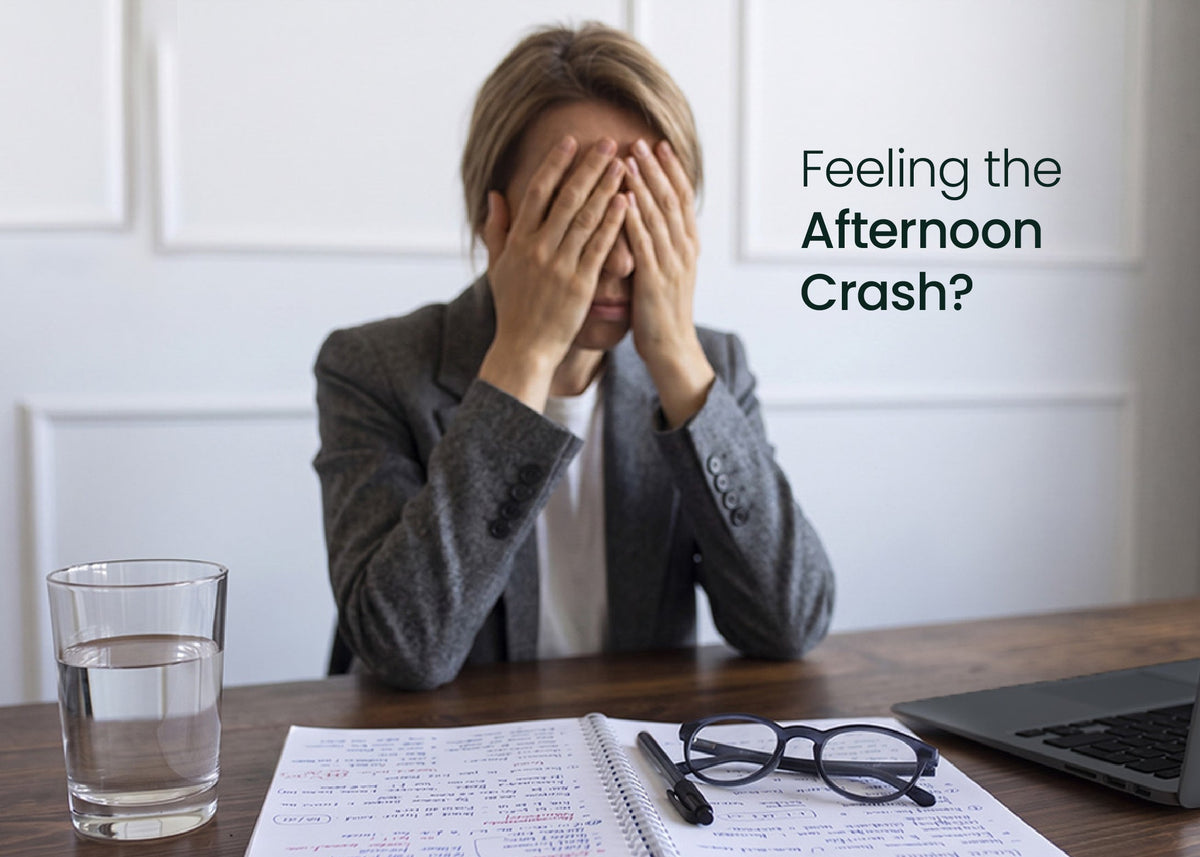
Why We Crash Every Afternoon (and What Helps)
Why It Happens
The afternoon crash is not one thing going wrong. It is a few normal rhythms in our bodies lining up at the same time of day. Once we see what they are, the whole thing makes more sense.
The body clock has an afternoon dip
Our bodies run on an internal clock, and it does more than tell us when to sleep. It also raises and lowers our energy at set times of day. One of those lows lands in the early afternoon. It arrives whether or not we ate lunch.¹ It is natural, and one of the biggest reasons we feel so wiped by mid-afternoon.
A sleep signal builds up all day
From the moment we wake up, a molecule called adenosine starts to build up in the brain. This is what makes us feel sleepy as the day goes on.² The longer we are awake, the more we collect, and the sleepier we feel. By the afternoon we have collected so much that what was easy in the morning now takes forever.
A heavy lunch adds to it
What we eat matters too. A heavy lunch, especially a carb-heavy one, makes the dip worse.¹ The timing is the catch. It lands right on top of the afternoon dip, until we barely have the energy for anything. So we go looking for a way through, and for most of us that means another coffee.
Which is where coffee comes in
Caffeine helps for a while, but it has its own timing issues, both when it wears off and how late we drink it. That is a whole topic on its own, and we get into it in Is Rhodiola a Better Alternative to Caffeine.
Taking the Edge Off
A few small things take the edge off.
Where Salidroside Comes In
Salidroside is the main active compound in rhodiola,⁵ a plant used for a long time to fight fatigue.
So What Do We Do?
The afternoon crash is mostly our bodies doing what they are built to do. We cannot switch off the body clock or the build-up of adenosine. But a few small habits take the edge off, and we can support the tiredness underneath.
References
-
Monk TH. The post-lunch dip in performance. Clin Sports Med. 2005;24(2):e15-e23, xi-xii. doi:10.1016/j.csm.2004.12.002
-
Reichert CF, Maire M, Schmidt C, Cajochen C. Sleep-Wake Regulation and Its Impact on Working Memory Performance: The Role of Adenosine. Biology (Basel). 2016;5(1):11. doi:10.3390/biology5010011
-
Münch M, Bromundt V. Light and chronobiology: implications for health and disease. Dialogues Clin Neurosci. 2012;14(4):448-453. doi:10.31887/DCNS.2012.14.4/mmuench
-
Tajiri E, Yoshimura E, Tobina T, et al. Effects of sleep restriction on food intake and appetite under free-living conditions: A randomized crossover trial. Appetite. 2023;189:106998. doi:10.1016/j.appet.2023.106998
-
Schwarz NA, Stratton MT, Colquhoun RJ, et al. Salidroside and exercise performance in healthy active young adults: an exploratory, randomized, double-blind, placebo-controlled study. J Int Soc Sports Nutr. 2024;21(1):2433744. doi:10.1080/15502783.2024.2433744
-
Ju L, Wen X, Wang C, et al. Salidroside, A Natural Antioxidant, Improves β-Cell Survival and Function via Activating AMPK Pathway. Front Pharmacol. 2017;8:749. doi:10.3389/fphar.2017.00749
Quick FAQ
Leer más
You've probably already heard rhodiola is worth a try. Maybe a friend mentioned it, or it kept coming up in the same breath as stress and energy. So the question isn't whether to try it. It's the p...
If you've spent any time on wellness TikTok, you've met sea moss by now. A jar of jewel-colored gel, a big promise, and a price that makes you wonder if it's worth it. Sea moss is a type of red se...
Dejar un comentario
Todos los comentarios se revisan antes de su publicación.
Este sitio está protegido por hCaptcha y se aplican la Política de privacidad de hCaptcha y los Términos del servicio.