


What Happens to Our Body as We Age?
The Energy Molecule Runs Low
When you hear the word energy, you probably think about whether you feel tired or wide awake. For your cells, it means something more specific. They turn the food you eat into a usable fuel called ATP, and that conversion depends on a molecule called NAD+.¹ When NAD+ runs low, your cells have less energy to work with.²
The Switches Gets Sluggish
Your cells rely on switches too.
Cells Wear Out and Linger
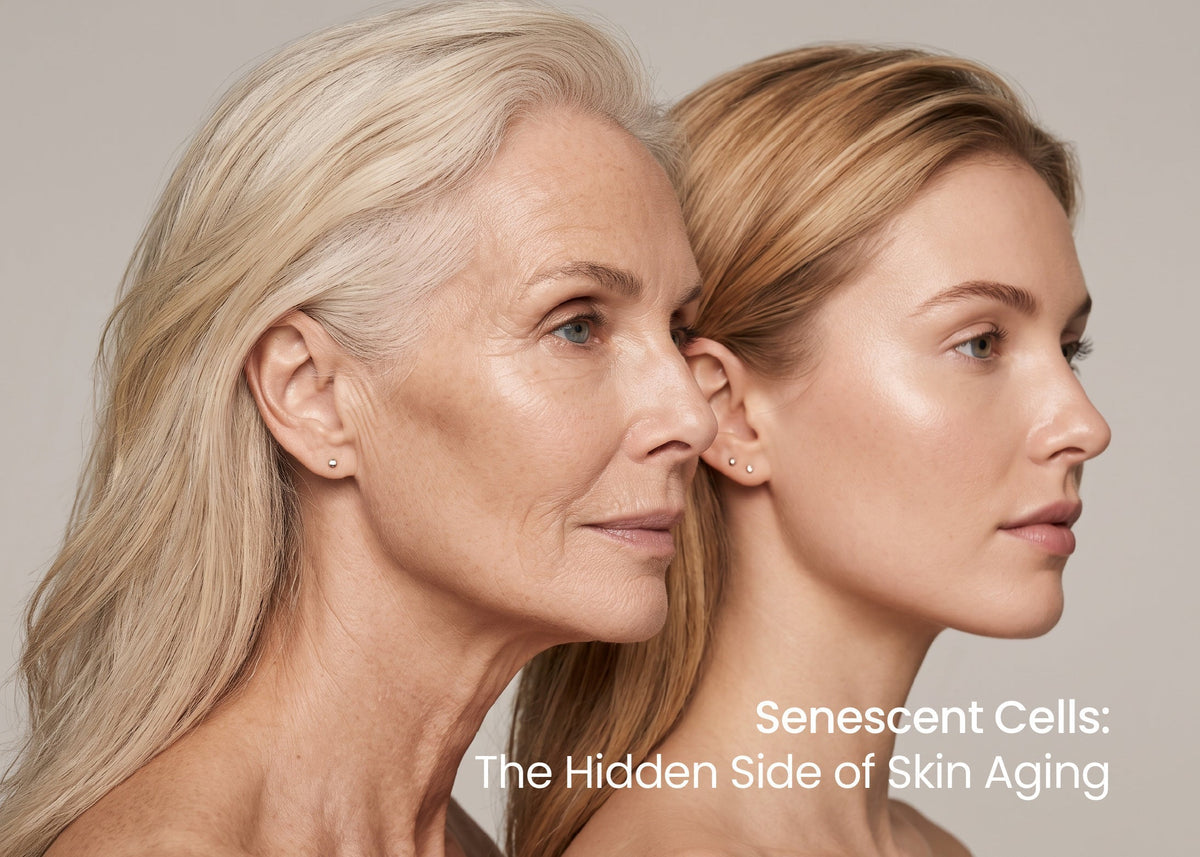
As the years pass, your cells take on damage, and the worn-out ones are meant to be cleared away to make room for fresh ones. Sometimes that doesn't happen. A damaged cell shuts down and waits to be cleared, but the help never comes. Just by staying, it starts making trouble for the healthy cells around it.⁶ There's a whole story in how that unfolds, and we told it in full in [Meet the Zombie Cells Aging Your Body article].
That Lingering Turns Inflammatory
The signals those worn-out cells send are inflammatory, and inflammation isn't a bad thing on its own.⁸ In short bursts it helps, it's how your body handles a cut or a cold. What wears on you is the low, steady kind that builds with age, unevenly, more in some people than others.⁹
Where that Leaves Us
None of this is your body breaking down. It's a machine that's been running a long time, and like any machine, the parts move a little slower with the miles.
References
-
Amjad S, Nisar S, Bhat AA, et al. Role of NAD+ in regulating cellular and metabolic signaling pathways. Mol Metab. 2021;49:101195. doi:10.1016/j.molmet.2021.101195
-
Hopp AK, Grüter P, Hottiger MO. Regulation of glucose metabolism by NAD+ and ADP-ribosylation. Cells. 2019;8(8):890. doi:10.3390/cells8080890
-
Massudi H, Grant R, Braidy N, et al. Age-associated changes in oxidative stress and NAD+ metabolism in human tissue. PLoS One. 2012;7(7):e42357. doi:10.1371/journal.pone.0042357
-
Peluso A, Damgaard MV, Mori MAS, et al. Age-dependent decline of NAD+ — universal truth or confounded consensus? Nutrients. 2021;14(1):101. doi:10.3390/nu14010101
-
Borra MT, Smith BC, Denu JM. Mechanism of human SIRT1 activation by resveratrol. J Biol Chem. 2005;280(17):17187-17195. doi:10.1074/jbc.M501250200
-
Ajoolabady A, Pratico D, Bahijri S, et al. Hallmarks of cellular senescence: biology, mechanisms, regulations. Exp Mol Med. 2025;57:1482-1491. doi:10.1038/s12276-025-01480-7
-
Pitozzi V, Mocali A, Laurenzana A, et al. Chronic resveratrol treatment ameliorates cell adhesion and mitigates the inflammatory phenotype in senescent human fibroblasts. J Gerontol A Biol Sci Med Sci. 2013;68(4):371-381. doi:10.1093/gerona/gls183
-
Ohtani N. The roles and mechanisms of senescence-associated secretory phenotype (SASP): can it be controlled by senolysis? Inflamm Regen. 2022;42(1):11. doi:10.1186/s41232-022-00197-8
-
Franck M, Daunizeau C, Aronoff JE, et al. Inflamm-aging as a diverse and context-dependent process: from species and population differences to individual trajectories. Ageing Res Rev. 2025;113:102880. doi:10.1016/j.arr.2025.102880
Quick FAQ
Leer más
Every cell in your body has a life cycle. It's born, it does its work, and when it's worn out or damaged, it retires, and your body clears it away to make room for a fresh one. It happens billions ...

Turmeric is having a moment. It's in the latte at your coffee shop, the wellness shot by the register, the golden milk your friend swears by before bed. A spice that used to live in the back of th...
Dejar un comentario
Todos los comentarios se revisan antes de su publicación.
Este sitio está protegido por hCaptcha y se aplican la Política de privacidad de hCaptcha y los Términos del servicio.