Skip to content

Cart

Your cart is empty

Continue shopping

Sign Up & Unlock 15% Off Neumina

Join the Neumina community today! Use code: WELCOME15 at checkout.

Enter your email above to instantly activate your 15% off code for your first purchase.

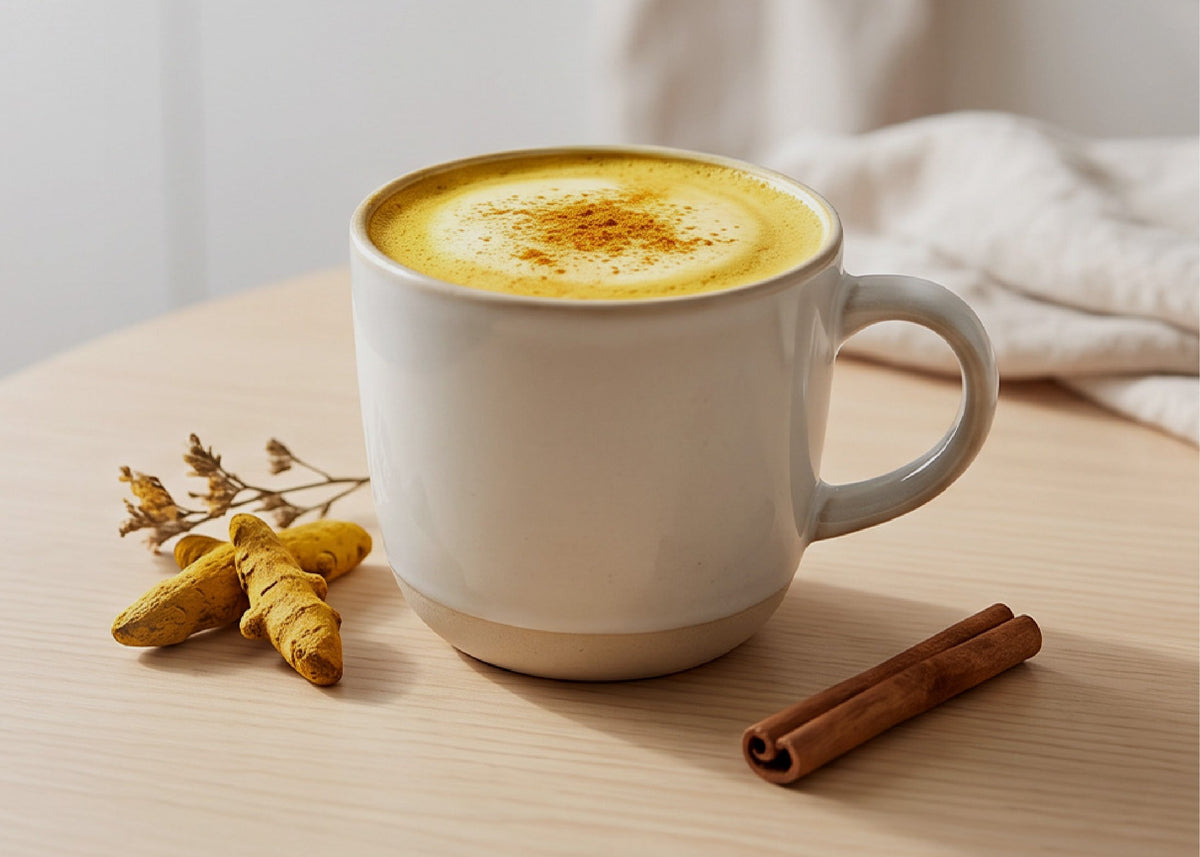
Your Turmeric Latte, Explained
Sep 3, 20264 min read

Your Turmeric Latte, Explained

Turmeric is having a moment.

It's in the latte at your coffee shop, the wellness shot by the register, the golden milk your friend swears by before bed. A spice that used to live in the back of the cupboard is suddenly the main ingredient, and people are building whole morning routines around it.

Some of that shine is earned. Turmeric has a long history, and there's real science behind it, and some of it runs ahead of what we can actually say. So let's sort out which is which.

So, Is It True?

Mostly, it comes back to inflammation.


Not the kind that heals a cut or helps us fight off a cold. We're talking about chronic inflammation. The slow kind that builds with age and doesn't switch off.¹ A lot of it comes from the "zombie" cells we've written about, still stirring up trouble.² Be sure to check it out in [Meet the Zombie Cells Aging Your Body]. But there's more to chronic inflammation than just them, and turmeric is where this gets interesting.

Turmeric's active compound is curcumin, and it's the part researchers care about. Curcumin is studied for its anti-inflammatory properties.³ The work is early, but it's a promising direction.

The Second Half of The Story

To see the rest, it helps to picture the body for what it is: a machine that's been running, without a break, for decades.


Like anything mechanical, it throws off a bit of exhaust as it goes. Every time your cells turn food into energy, they release a few unstable molecules called free radicals. And like any good engine, it comes with its own cleanup built in, so for most of your life it clears them as fast as it makes them.

But the parts wear with age. What once mopped up those free radicals starts to slow, and they pile up faster than the body can clear them. That buildup has a name: oxidative stress. A bit of exhaust you handled for decades slowly becomes something you can't quite keep up with.

Oxidative stress and chronic inflammation aren't two separate problems. They're one aging engine, running rougher with the years, showing the strain in two different ways.

This is what draws researchers to curcumin. It's studied for both sides of that strain at once: looked at for the free radicals on one hand, and the inflammation on the other.³ Early work, but it's rare for a single compound to sit where both meet.

Getting It to Work

There's a catch the trend rarely mentions. Curcumin is difficult for your body to absorb. Take it on its own and most of it passes straight through, which means a plain turmeric shot may be delivering far less than you'd think.


The good news is that a few simple things help, and the traditional recipes landed on most of them by instinct:
  • Warm it up. Curcumin doesn't dissolve well in cold liquid, it tends to sit there as undissolved powder. Gentle heat helps it dissolve, which is one reason golden milk is served warm rather than cold.⁴
  • Pair it with fat. Curcumin is fat-soluble, so it slips into your system more easily when there's a little fat along for the ride. The milk in a latte or golden milk does this job nicely.⁵
  • Add black pepper. A compound in black pepper called piperine noticeably improves how much curcumin you absorb. It's the single most effective trick on this list, and it's why you'll see pepper in so many traditional turmeric recipes.⁶
Notice how much of that the old recipes already got right. Warm milk, a pinch of pepper, that combination isn't random. It's the tradition working with the biology, long before anyone measured why.

And it's the same logic behind how the formula is built. The turmeric comes paired with black pepper, so the absorption problem is handled for you, no shot glass or saucepan required.

Where that Leaves Us

So, is the trend onto something? Mostly, yes.


Turmeric is worth the attention. The curiosity that put it in your latte and your morning shot is pointing at something real, a spice people have leaned on for centuries that researchers are now taking seriously.

The interesting part is what happens next. On its own, curcumin is hard to absorb, but the old recipes solved that long ago, and it's the same reason the formula pairs turmeric with pepper from the start.

Explore Neumina's NAD+ Complex →

So enjoy the golden latte. Those small touches around it are what turn a nice ritual into one your body can make the most of.

These statements have not been evaluated by the Food and Drug Administration. This product is not intended to diagnose, treat, cure, or prevent any disease.

References

  1. Franck M, Daunizeau C, Aronoff JE, et al. Inflamm-aging as a diverse and context-dependent process: from species and population differences to individual trajectories. Ageing Res Rev. 2025;113:102880. doi:10.1016/j.arr.2025.102880
  2. Ohtani N. The roles and mechanisms of senescence-associated secretory phenotype (SASP): can it be controlled by senolysis? Inflamm Regen. 2022;42(1):11. doi:10.1186/s41232-022-00197-8
  3. Nunes YC, Mendes NM, Pereira de Lima E, et al. Curcumin: a golden approach to healthy aging: a systematic review of the evidence. Nutrients. 2024;16(16):2721. doi:10.3390/nu16162721
  4. Jagannathan R, Abraham PM, Poddar P. Temperature-dependent spectroscopic evidences of curcumin in aqueous medium: a mechanistic study of its solubility and stability. J Phys Chem B. 2012;116(50):14533-14540. doi:10.1021/jp3050516
  5. Schönenberger KA, Ranzini C, Laval J, et al. The influence of food matrices on the bioavailability of curcuminoids from a dried colloidal turmeric suspension: a randomized, crossover, clinical trial. Food Funct. 2025;16(2):774-784. doi:10.1039/d4fo03414g
  6. Pan C, Wang S, Yang Y, et al. Curcumin-piperine supplementation modulates inflammation, oxidative stress, and cardiometabolic risk: a systematic review of randomized controlled trials. Front Nutr. 2026;13:1814168. doi:10.3389/fnut.2026.1814168
Share

Leave a comment

All comments are moderated before being published.

This site is protected by hCaptcha and the hCaptcha Privacy Policy and Terms of Service apply.

Quick FAQ

Amy Qin, PhD, RD, CDCES, Nutrition Scientist at Neumina

Amy Qin is a Nutrition Scientist at Neumina with training in both nutrition research and clinical care. She received her PhD in Nutrition and Metabolism from the University of Wisconsin-Madison and completed clinical training at Stanford Hospital and UCSF Benioff Children's Hospital.

Her work focuses on applying nutrition science to metabolism, aging, and chronic disease management in ways that are practical and personalized.