


The sleep supplements worth knowing, honestly ranked
It's 1 am and you're still awake, scrolling.
Somewhere in that scroll is a video about sleep. A "sleepy girl mocktail," a magnesium powder, a gummy someone swears changed their life. The sleep aisle has never been bigger, and it keeps growing, powders, teas, sprays, capsules, each promising to be the thing that finally works.
Some of it is worth your attention. Some of it is marketing wearing a lab coat. And the truth is simpler than the hype: they help in small, specific ways. The one that works for you depends on what's keeping you up.
So here's an honest look at the sleep supplements backed by real research. What each one does, who it's for, and which ones are running on hype.
1. Magnesium
Best for : winding down and falling asleep faster.
Magnesium is the one most people reach for first, and it's a reasonable place to start. It plays a role in relaxing your muscles and calming the nervous system, the shift your body does to settle down at night. In a review of studies in older adults, magnesium helped people fall asleep about 17 minutes faster than a placebo.¹
It works best if you're a little low on magnesium to start with, which is more common than you'd think. And it's cheap, easy on the system, and a sensible first thing to try.
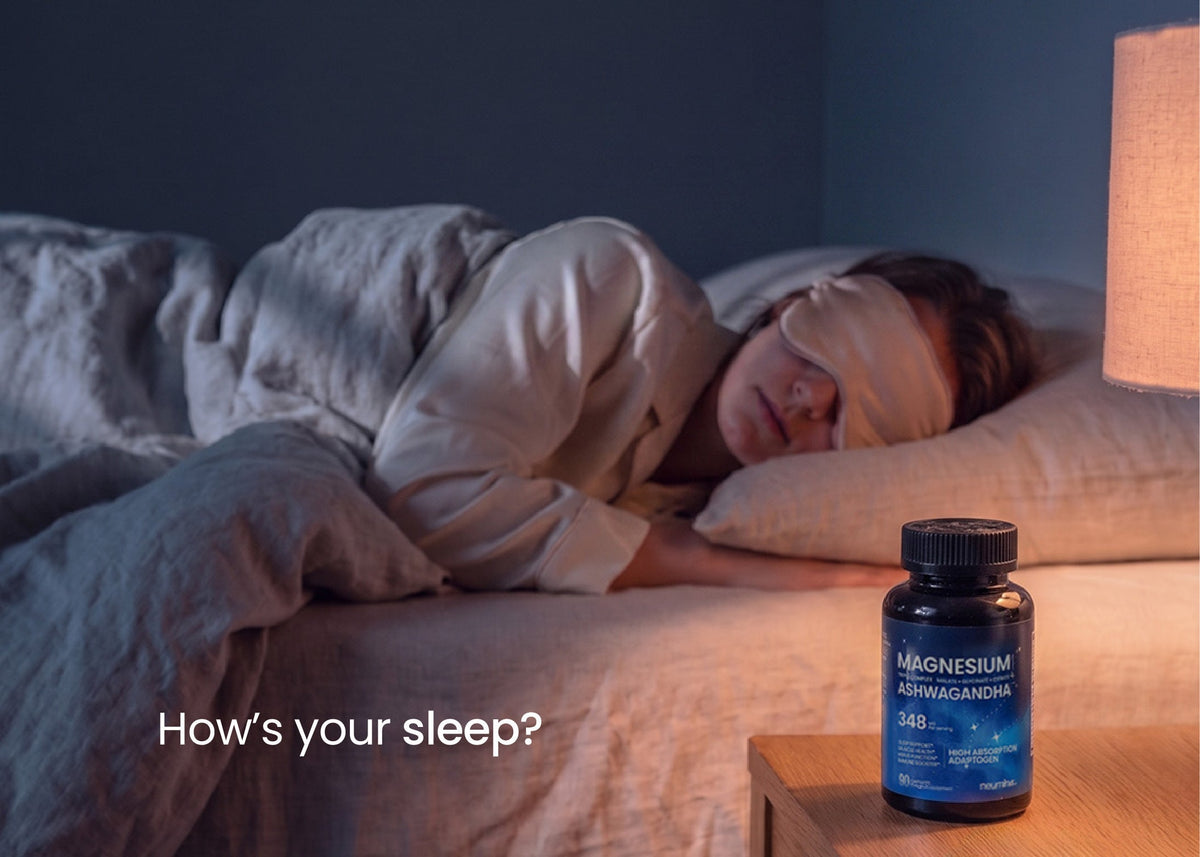
Curious how we do it in Neumina? Be sure to check out our [Triple Magnesium Complex & Ashwagandha]
2. Melatonin
Best for : resetting your body's clock, jet lag, late nights, shift work.
Melatonin is the most studied sleep supplement there is, but it's also the most misunderstood. It isn't a sedative and it won't knock you out. Think of it as a subtle alarm telling your body it's nighttime, so it nudges you toward sleep rather than forcing it.
That's why it shines for travel and schedule changes. Across a large body of research, it helped people fall asleep around 7 minutes faster and sleep a little longer.² A modest effect, but a steady one, and it doesn't seem to go away with use.
The catch is how people take it. More isn't better here, and a smaller dose earlier in the evening often works better than a big one right before bed. If your body clock is out of sync, this is the one to reach for.
3. Ashwagandha
Best for : the nights your mind won't stop running.
Stress and sleep feed each other. That stress makes your body hold on to too much cortisol, and high cortisol keeps you alert at night when you're trying to sleep, so you lie there awake, which only makes you more stressed, and the whole thing loops back around.
Ashwagandha works on that first link. In studies, it lowered cortisol, taking some pressure off the part of the cycle that keeps you switched on.³ And on sleep itself, it showed a small but real benefit, a bit better rest, and easier mornings.⁴
It's not an instant fix. It works best taken consistently over a few weeks, so it suits ongoing, stress-heavy stretches more than the occasional rough night.
We also add this compound in our [Triple Magnesium Complex & Ashwagandha]
4. L-theanine
Best for : taking the edge off a wired mind, tonight.
If ashwagandha is for the stressful stretch, L-theanine is for the single restless night. It's an amino acid found in tea, and it's known for a specific kind of calm: it relaxes you without making you drowsy or foggy. You feel relaxed, but still clear-headed.
That makes it a good fit when your body is tired but your mind is still buzzing. A review of the research found that 200 to 450mg supports better sleep, helping people fall asleep more easily and wake up feeling more rested.⁵
It works the same night, rather than needing weeks to build up. A simple way to settle a busy head at bedtime.
5. Glycine
Best for : dropping off faster and sleeping more deeply.
Glycine is an amino acid that seems to help you fall asleep sooner and reach deep sleep faster. One idea for how it works is that it helps your core body temperature ease down at night, which is one of the natural signals that tells your body it's time to sleep.
In studies, people taking around 3 grams before bed reported better sleep and felt sharper the next day.⁶ The research here is still early, with smaller studies than some of the others on this list, but the results so far are promising, and glycine is cheap and easy to tolerate.
A good one to try if falling asleep, or falling into deep sleep, is where you struggle.
Trending, with an Asterisk
Two honorable mentions, since they're everywhere right now.
Apigenin. The big one on social media lately. Here's the catch: almost all the human sleep research is on chamomile, not the isolated apigenin in those capsules, and even the chamomile evidence is shaky, it may help you stay asleep, but not much else.⁷ The trendy pill isn't the thing that was studied.
Valerian. An old herbal standby that might genuinely help. The problem is consistency: valerian products vary wildly, and the active compounds are unstable, so what's in your bottle may not match what worked in a study.⁸ Promising, but a bit of a gamble.
Where that Leaves You
Sleep isn't one problem with one answer. It has a lot of moving parts, your stress, your body clock, how easily you can wind down. The right nudge depends on which part is getting in your way.
That's the useful thing to walk away with. A sense of which one fits your nights. If stress is the culprit, you know where to look. If it's your schedule, somewhere else.
A couple of these, magnesium and ashwagandha, you'll find them in our own lineup. Matching the right support to the sleep you're missing.
*These statements have not been evaluated by the Food and Drug Administration. This product is not intended to diagnose, treat, cure, or prevent any disease.
References
-
Mah J, Pitre T. Oral magnesium supplementation for insomnia in older adults: a systematic review & meta-analysis. BMC Complement Med Ther. 2021;21(1):125. doi:10.1186/s12906-021-03297-z
-
Ferracioli-Oda E, Qawasmi A, Bloch MH. Meta-analysis: melatonin for the treatment of primary sleep disorders. PLoS One. 2013;8(5):e63773. doi:10.1371/journal.pone.0063773
-
Albalawi AA. Dual impact of ashwagandha: significant cortisol reduction but no effects on perceived stress, a systematic review and meta-analysis. Nutr Health. 2025;31(4):1395-1408. doi:10.1177/02601060251363647
-
Cheah KL, Norhayati MN, Husniati Yaacob L, Abdul Rahman R. Effect of ashwagandha (Withania somnifera) extract on sleep: a systematic review and meta-analysis. PLoS One. 2021;16(9):e0257843. doi:10.1371/journal.pone.0257843
-
Cotter J, Caddick CE, Harper JL, Ebajemito JK. Examining the effect of L-theanine on sleep: a systematic review of dietary supplementation trials. Nutr Neurosci. 2026;29(2):224-238. doi:10.1080/1028415X.2025.2556925
-
Soh J, Raventhiran S, Lee JH, et al. The effect of glycine administration on the characteristics of physiological systems in human adults: a systematic review. Geroscience. 2024;46(1):219-239. doi:10.1007/s11357-023-00970-8
-
Kazemi A, Shojaei-Zarghani S, Eskandarzadeh P, Hashempur MH. Effects of chamomile (Matricaria chamomilla L.) on sleep: a systematic review and meta-analysis of clinical trials. Complement Ther Med. 2024;84:103071. doi:10.1016/j.ctim.2024.103071
-
Shinjyo N, Waddell G, Green J. Valerian root in treating sleep problems and associated disorders, a systematic review and meta-analysis. J Evid Based Integr Med. 2020;25:2515690X20967323. doi:10.1177/2515690X20967323
Share
Leave a comment
All comments are moderated before being published.
This site is protected by hCaptcha and the hCaptcha Privacy Policy and Terms of Service apply.