Skip to content

Cart

Your cart is empty

Continue shopping

Sign Up & Unlock 15% Off Neumina

Join the Neumina community today! Use code: WELCOME15 at checkout.

Enter your email above to instantly activate your 15% off code for your first purchase.

Is Rhodiola Safe? What The Research Shows
Jul 30, 20264 min read

Is Rhodiola Safe? What The Research Shows

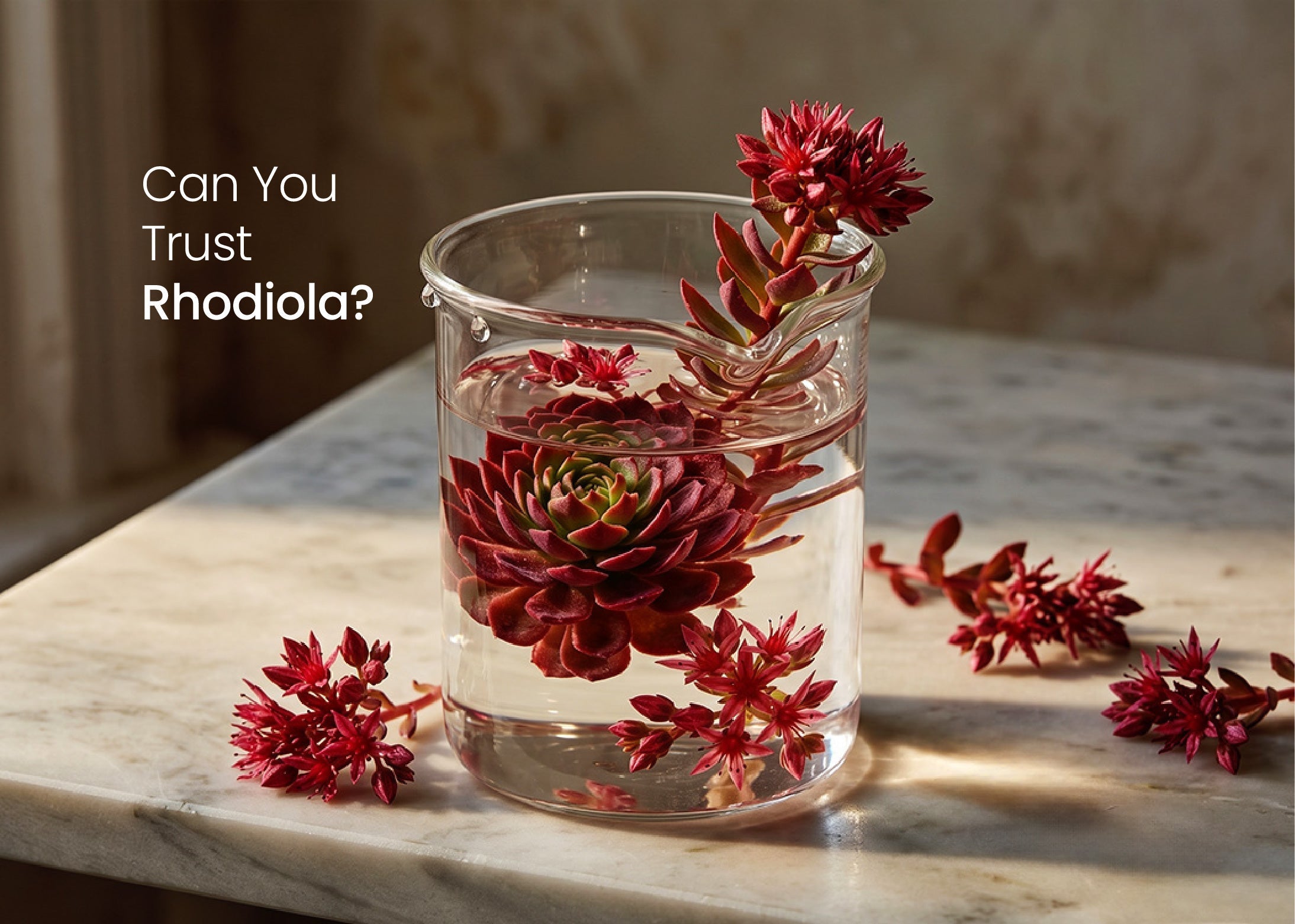
You've probably already heard rhodiola is worth a try. Maybe a friend mentioned it, or it kept coming up in the same breath as stress and energy. So the question isn't whether to try it. It's the practical questions that come next: is it safe, how much do I take, and when. Let's go through them, one by one.

Safe? Mostly Yes

Rhodiola has a long history of use, and the research so far backs that up. A 2011 review pulled together eleven placebo-controlled trials. The quality was mostly decent, and only a few mild side effects turned up across all of them.¹


That same review made a fair point. These results haven't been widely repeated by independent teams yet.¹ So the picture looks good, based on real trials, but the research is still emerging.

Salidroside is considered rhodiola's main active ingredient.² There's now an early human study that tested salidroside on its own. In it, salidroside was well tolerated, with side effects no different from a placebo.²

So both point the same way. Rhodiola has a long track record, and the early research on salidroside fits it.

Is There a Limit?

This is the part people usually expect to be complicated, and it usually isn't. The more useful question is whether there's a limit, a point where you're taking too much. On that, the research is reassuring.

Here's what the studies actually show:
  • The trials used doses ranging from about 170 to 680 mg a day.¹
  • Even at the high end, 680 mg a day for six weeks, no serious side effects were reported.³
  • More is not better. Higher doses haven't been shown to add any benefit.

In Neumina, we use 60mg of the active ingredient, Salidroside. This is also the dose used in the one human study of salidroside on its own.² Alos, much higher amounts, around 2000mg, caused no problems in animal trials.⁴ Talking safety, 60 mg is a sensible, well-studied amount with plenty of room to spare.


What that dose does in the body is a bigger topic, and we get into it in One compound, a lot of claims.

One thing that's easy to miss is on the label itself. Because rhodiola is a plant, the amount of salidroside inside isn't fixed. It shifts depending on where it's grown and how it's processed. So two products with the same milligram number can still deliver different amounts of the active. A set dose of salidroside skips that guesswork.

One practical note: it works with or without food, so take it whenever suits you.

Morning or Night?

People right now are divided on this. Some take rhodiola in the morning for energy and focus, which trials do support.⁴ Others take it at night, hoping it helps them wind down.


So which is right? Here is the part that clears it up. Salidroside does the same thing whenever you take it. In one early trial, people taking it held steady on mood and performance under stress, while the placebo group slipped.² The effect does not change with the clock, so the question was never really morning or night.

It is what you are taking it for. If you want energy and focus, the morning fits, since that is when you want the lift. If you want to take the edge off a wired, over-alert feeling, later can work too. Same effect, different reason. We get into how Salidroside does this in One compound, a lot of claims.

One last note. If you are pregnant, nursing, or taking prescription medication, it is worth running it past your doctor first.

Where This Leaves You

Rhodiola comes out looking like a reasonable thing to try. The safety record is good, a moderate daily dose is all you need, and when you take it comes down to what you want from it.


The one catch is the one we kept coming back to. With whole-plant rhodiola, you cannot be sure how much salidroside you are actually getting. That is the part a defined dose fixes.

This is where our 98% High-Purity Salidroside comes in. Instead of a plant extract that varies, it gives you a set amount of the active, the same every time. You are not guessing, and you are not paying for filler around it. Explore Neumina's High-Purity 98% Salidroside Rhodiola Adaptogen →

Salidroside is a well-studied compound with a sensible, steadying effect, and the research on it is still growing. If that is the kind of thing you are looking for, taking it in a clean, known dose is a simple way to give it a fair try.

These statements have not been evaluated by the Food and Drug Administration. This product is not intended to diagnose, treat, cure, or prevent any disease.

References

  1. Hung SK, Perry R, Ernst E. The effectiveness and efficacy of Rhodiola rosea L.: a systematic review of randomized clinical trials. Phytomedicine. 2011;18(4):235-244. doi:10.1016/j.phymed.2010.08.014
  2. Schwarz NA, Stratton MT, Colquhoun RJ, et al. Salidroside and exercise performance in healthy active young adults: an exploratory, randomized, double-blind, placebo-controlled study. J Int Soc Sports Nutr. 2024;21(1):2433744. doi:10.1080/15502783.2024.2433744
  3. Darbinyan V, Aslanyan G, Amroyan E, et al. Clinical trial of Rhodiola rosea L. extract SHR-5 in the treatment of mild to moderate depression. Nord J Psychiatry. 2007;61(5):343-348. doi:10.1080/08039480701643290
  4. Spasov AA, Wikman GK, Mandrikov VB, et al. A double-blind, placebo-controlled pilot study of the stimulating and adaptogenic effect of Rhodiola rosea SHR-5 extract on the fatigue of students caused by stress during an examination period with a repeated low-dose regimen. Phytomedicine. 2000;7(2):85-89. doi:10.1016/S0944-7113(00)80078-1
Share

Leave a comment

All comments are moderated before being published.

This site is protected by hCaptcha and the hCaptcha Privacy Policy and Terms of Service apply.

Quick FAQ

Amy Qin, PhD, RD, CDCES, Nutrition Scientist at Neumina

Amy Qin is a Nutrition Scientist at Neumina with training in both nutrition research and clinical care. She received her PhD in Nutrition and Metabolism from the University of Wisconsin-Madison and completed clinical training at Stanford Hospital and UCSF Benioff Children's Hospital.

Her work focuses on applying nutrition science to metabolism, aging, and chronic disease management in ways that are practical and personalized.