


Sleep and Thermoregulation System
Why Sleep and Temperature Are So Tightly Linked
Good sleep depends on a small drop in your core body temperature. Your body cools slightly to fall asleep, then holds it there, which estrogen helps keep steady.¹ Deep in your brain sits the hypothalamus, your body's thermostat. Its job is to keep you within a comfortable temperature range. That range has room to spare, so when your temperature rises or dips a little overnight, your body does not have to react, no sweating to cool down, no shivering to warm up. And because it does not react, those small changes never wake you. Scientists call this range the thermoneutral zone, and steady estrogen keeps it wide.³
Why the Nights Get So Broken
Night sweats damage sleep by breaking it into pieces, not just by waking you once. For women who get them every night, they can come back several times before morning,⁴ and each one can pull you out of the deep, restful sleep your body needs most. The worse the night sweats, the worse the disruption: women with moderate to severe symptoms are almost three times as likely to wake repeatedly in the night as women without them.⁵
What May Help
Sleep does not reset overnight, but a few changes genuinely make these nights easier. For the hot flashes and night sweats themselves, the most effective medical option is hormone therapy, which is worth raising with your doctor.⁸ Alongside that, a great deal is in your own hands. Keeping your bedroom cool and your bedding light and breathable gives your body less heat to fight in the first place. A steady sleep and wake time, even on weekends, helps the whole system settle into a more predictable rhythm. And easing off alcohol and late caffeine helps, since both can nudge your temperature and your nervous system in the wrong direction right when you are trying to settle.
How This Changes From Perimenopause to Postmenopause
What you feel does not stay the same across this whole stretch. Trouble falling and staying asleep tends to climb through the transition and stay high afterward, while waking too early often eases once you are postmenopausal.¹⁴ Hot flashes and night sweats follow their own curve: more perimenopausal women get them than postmenopausal women.⁴ The pattern below is a rough map, not a fixed schedule, since it varies a lot from one woman to the next.
Perimenopause vs postmenopause
| What you might notice | Perimenopause | Postmenopause |
| Trouble falling or staying asleep | Climbs through the transition | Stays elevated, does not ease on its own |
| Waking too early | Worsens, often worst in late perimenopause | Tends to improve |
| Hot flashes and night sweats (how common) | More women have them (~79%) | Fewer women have them (~65%) |
Frequently Asked Questions
What makes hot flashes and night sweats worse?
It's probably what you're already thinking: heat, alcohol, caffeine, spicy food, smoking, stress, the usual suspects. Caffeine is the one with the most research behind it, one large study linked it to worse hot flashes and night sweats in women who were already past menopause.¹⁵ That doesn't mean you have to quit coffee or give up spicy food. Everyone's different, so the real trick is noticing what sets yours off and easing back on those, especially at night, since these habits can cost you sleep on their own.
Is it normal to feel this exhausted, or is something wrong with me?
Yes, it's normal, and no, there's nothing wrong with you. Trouble sleeping is one of the most common parts of this whole transition.⁵ When your nights keep getting broken by night sweats, being wiped out the next day isn't weakness or you not coping. It's just what happens when sleep gets chopped into pieces night after night. The exhaustion is real, and it has a real cause.
Why do I freeze right after a night sweat?
Because your body is very good at cooling you down, and it overdoes it. It opens your blood vessels and makes you sweat to dump the heat fast, but it cools you a little too well, which is why you can feel like you're freezing a moment later.³ So the sweating and the shivering aren't two separate problems. They're the same response, just swinging a bit too far each way.
When should I see a doctor about night sweats?
Most of the time, night sweats in your 40s and 50s are hormonal and not a sign of anything dangerous.¹⁶ They're a general symptom though, not a menopause-only one, so once in a while they point to something else, like a thyroid problem or an infection.¹⁶ It's worth getting checked if they don't let up over time, so a doctor can rule out the less common causes. And see someone sooner if they come with things like a fever, unexplained weight loss, or new lumps. None of this is meant to scare you. It's just about making sure you're treating the right thing.
How Sleep Affects the Rest of Your Body
Sleep is not the only thing that suffers here. It sits at the top of a kind of waterfall, where one disruption spills into the next. The main guide covers how the fall in estrogen reaches several systems at once, and how those systems feed into one another. Sleep is one of the clearest examples. Once night sweats begin interrupting your nights, the broken sleep that follows starts to weigh on your mood, your memory, even the way your body manages weight, on top of what the drop in hormones is already doing. That is why protecting your sleep, and building a routine that supports it, matters so much. The benefit does not stay in your nights. It flows back out into the rest.
Broken sleep makes the mood and memory shifts of this stretch harder to handle. While you sleep, your brain does a kind of nightly housekeeping: it helps balance your emotions, and at a deeper level, it helps you hold on to the memories of what you did during the day. When night sweats keep cutting that work short, small things feel bigger the next morning, and the forgetfulness and mental fog so many women notice get heavier.¹⁷⁻¹⁸ And it goes both ways, because a busy, anxious mind makes it harder to fall asleep in the first place, so the two keep feeding each other. If that loop sounds familiar, the brain and nervous system guide in this series goes deeper into it.
Broken sleep also nudges your body toward weight gain, right when the transition is already pulling in that direction. After too little sleep, your hunger signals shift: the one that tells you that you are full gets quieter, and the one that says you are hungry gets louder, so you find yourself reaching for more.¹⁹ Poor sleep also makes it harder for your body to handle blood sugar.²⁰ One rough night will not change anything, but months of broken sleep can quietly add to the changes your body is already going through. The metabolism and weight guide in this series covers that side fully.
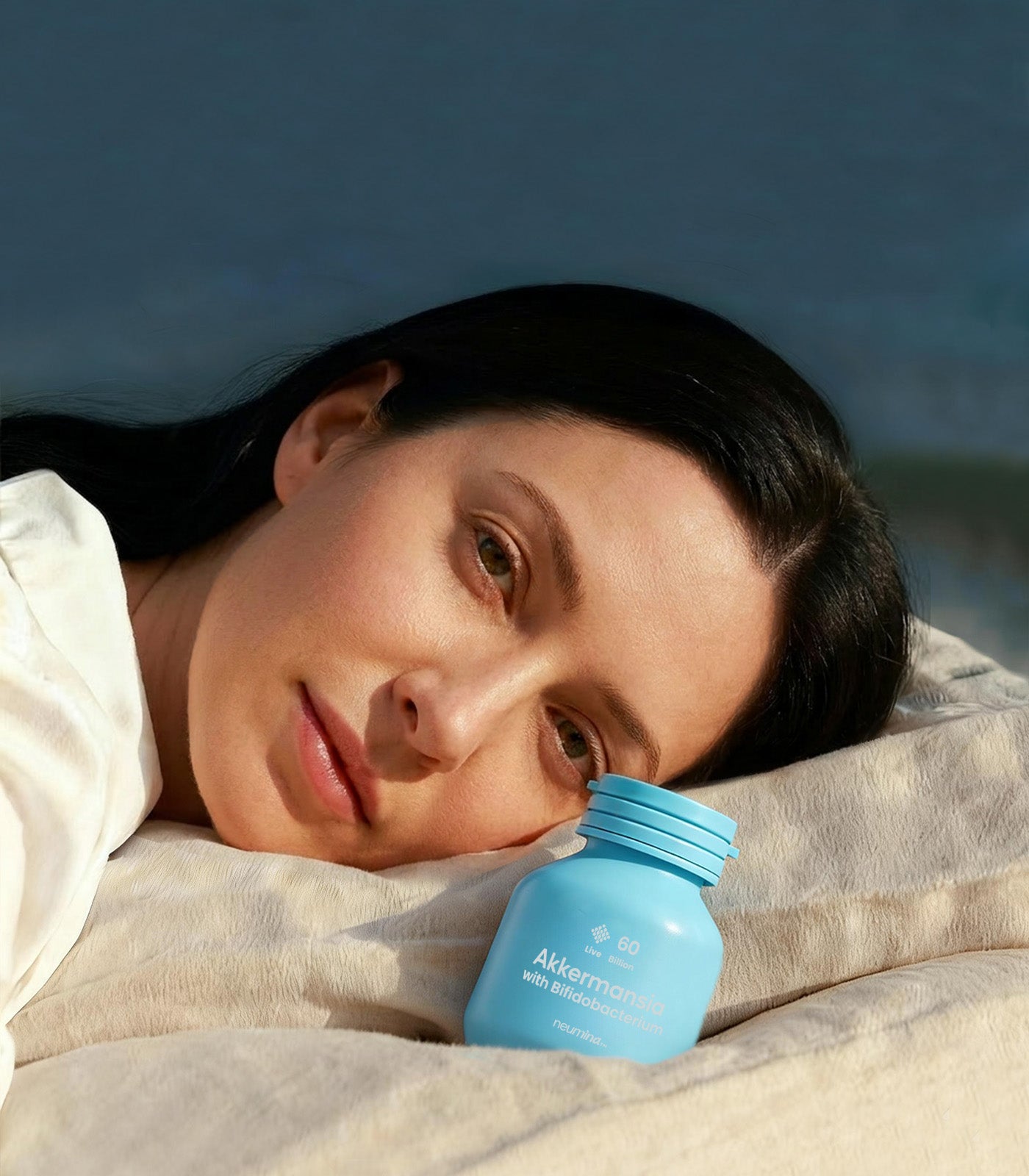
If cooler, calmer nights are what you are after, the Neumina Triple Magnesium Complex & Ashwagandha and Daily Nutrition Pack were both built with that goal in mind.
← Back to the full guide
References
-
Gombert-Labedens M, Vesterdorf K, Fuller A, Maloney SK, Baker FC. Effects of menopause on temperature regulation. Temperature (Austin). 2025;12:92-132.
-
Avis NE, Crawford SL, Greendale G, et al. Duration of menopausal vasomotor symptoms over the menopause transition. JAMA Intern Med. 2015;175(4):531-539. doi:10.1001/jamainternmed.2014.8063
-
Freedman RR, Krell W. Reduced thermoregulatory null zone in postmenopausal women with hot flashes. Am J Obstet Gynecol. 1999;181(1):66-70. doi:10.1016/s0002-9378(99)70437-0
-
Williams RE, Kalilani L, DiBenedetti DB, et al. Frequency and severity of vasomotor symptoms among peri- and postmenopausal women in the United States. Climacteric. 2008;11(1):32–43. doi:10.1080/13697130701744696
-
Breitinger-Blatt D, Lee J, Ribeiro Pereira SI, Smith C, Gavriloff D, Sekaran S. Cognitive behavioural therapeutics for insomnia symptoms in the perimenopause through to the early postmenopausal period. Cochrane Database Syst Rev. 2026;(4):CD016349. doi:10.1002/14651858.CD016349
-
Thurston RC, Chang Y, Buysse DJ, Hall MH, Matthews KA. Hot flashes and awakenings among midlife women. Sleep. 2019;42(9):zsz131. doi:10.1093/sleep/zsz131
-
Hirschberg AL, Polo-Kantola P, Øverlie I, et al. Prevalence and impact of vasomotor symptoms associated with menopause among Nordic women: subgroup analysis from an international cross-sectional survey. Acta Obstet Gynecol Scand. 2025;104:1575-1586. doi:10.1111/aogs.15139
-
"The 2022 Hormone Therapy Position Statement of The North American Menopause Society" Advisory Panel. The 2022 hormone therapy position statement of The North American Menopause Society. Menopause. 2022;29(7):767-794. doi:10.1097/GME.0000000000002028
-
McCurry SM, Guthrie KA, Morin CM, et al. Telephone-based cognitive behavioral therapy for insomnia in perimenopausal and postmenopausal women with vasomotor symptoms: a MsFLASH randomized clinical trial. JAMA Intern Med. 2016;176(7):913-920. doi:10.1001/jamainternmed.2016.1795
-
Schuster J, Cycelskij I, Lopresti A, Hahn A. Magnesium bisglycinate supplementation in healthy adults reporting poor sleep: a randomized, placebo-controlled trial. Nat Sci Sleep. 2025;17:2027–2040. doi:10.2147/NSS.S524348
-
Arab A, Rafie N, Amani R, Shirani F. The role of magnesium in sleep health: a systematic review of available literature. Biol Trace Elem Res. 2023;201(1):121-128. doi:10.1007/s12011-022-03162-1
-
Bannai M, Kawai N. New therapeutic strategy for amino acid medicine: glycine improves the quality of sleep. J Pharmacol Sci. 2012;118(2):145–148. doi:10.1254/jphs.11R04FM
-
Kawai N, Sakai N, Okuro M, et al. The sleep-promoting and hypothermic effects of glycine are mediated by NMDA receptors in the suprachiasmatic nucleus. Neuropsychopharmacology. 2015;40(6):1405–1416. doi:10.1038/npp.2014.326
-
Kravitz HM, Zhao X, Bromberger JT, et al. Sleep disturbance during the menopausal transition in a multi-ethnic community sample of women. Sleep. 2008;31(7):979-990.
-
Faubion SS, Sood R, Thielen JM, Shuster LT. Caffeine and menopausal symptoms: what is the association? Menopause. 2015;22(2):155-158. doi:10.1097/GME.0000000000000301
-
Bryce C. Persistent night sweats: diagnostic evaluation. Am Fam Physician. 2020;102(7):427-433.
-
Yoo SS, Gujar N, Hu P, Jolesz FA, Walker MP. The human emotional brain without sleep: a prefrontal amygdala disconnect. Curr Biol. 2007;17(20):R877-R878. doi:10.1016/j.cub.2007.08.007
-
Diekelmann S, Born J. The memory function of sleep. Nat Rev Neurosci. 2010;11(2):114-126. doi:10.1038/nrn2762
-
Taheri S, Lin L, Austin D, Young T, Mignot E. Short sleep duration is associated with reduced leptin, elevated ghrelin, and increased body mass index. PLoS Med. 2004;1(3):e62. doi:10.1371/journal.pmed.0010062
-
Singh P, Beyl RA, Stephens JM, et al. Effect of sleep restriction on insulin sensitivity and energy metabolism in postmenopausal women: a randomized crossover trial. Obesity (Silver Spring). 2023;31(5):1204-1215. doi:10.1002/oby.23739