



Salidroside VS Ashwagandha: Which One is Better for You?
Self-Checking your symptoms
To find out where your energy leak may be coming from, check off the next statements that most accurately describe how you feel right now:
Profile A: The Over-Stimulated Burnout
-
My mind is racing, but I'm too exhausted to actually get work done.
-
I feel jittery and with a weird tightness in my chest.
-
I can’t focus during the day, and I can't switch my brain off at night.
Profile B: The Depleted Engine Burnout
-
I don’t feel panicked or anxious, I just feel kind of empty.
-
My brain feels like it’s moving in slow-motion, like through a thick fog.
-
I get a massive crash of energy in the middle of the day.

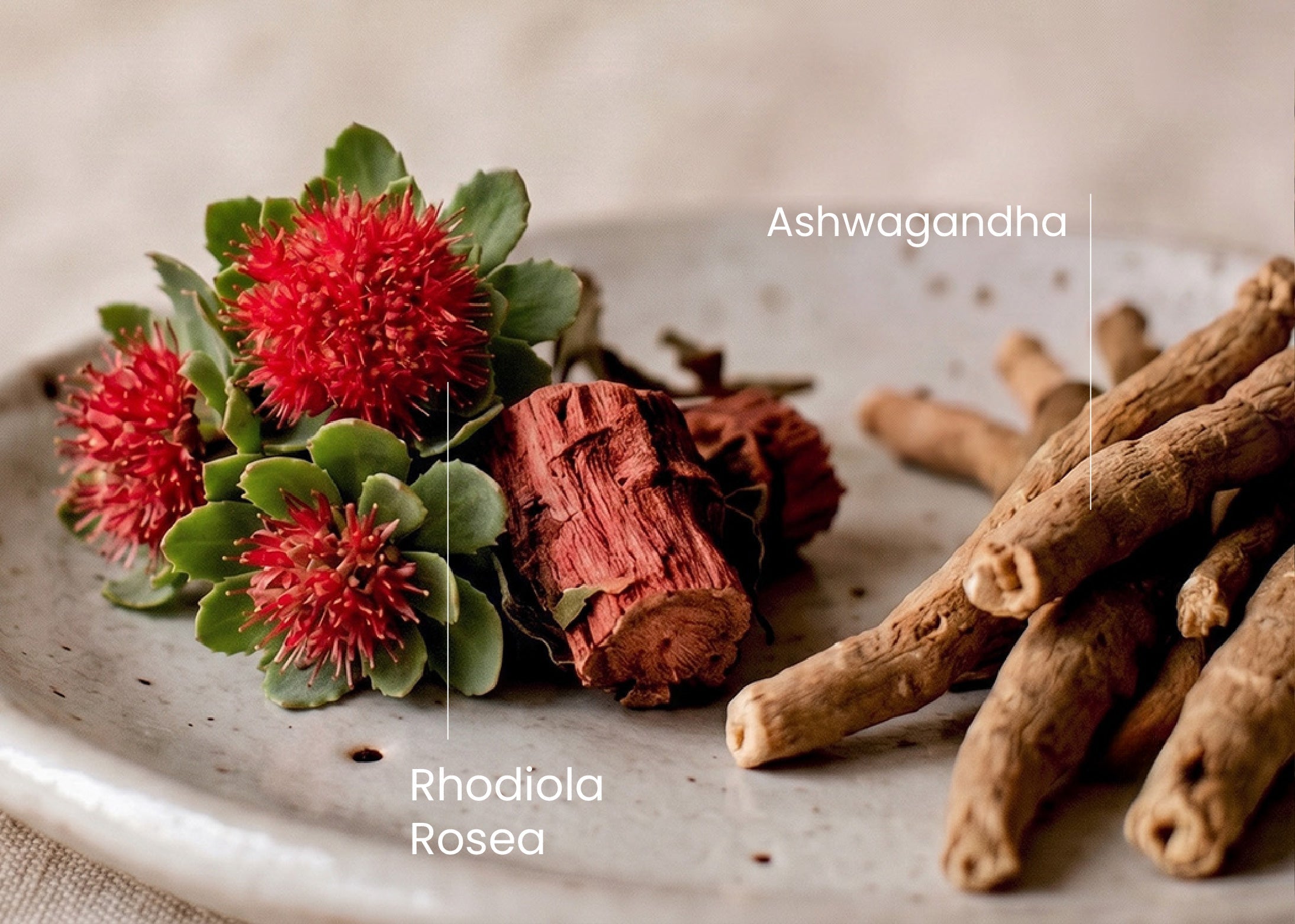
Ashwagandha: The Central Volume Knob
To understand Ashwagandha, think of your body’s stress response as an alarm. When deadlines stack up, or you are under heavy physical strain, your brain keeps that alarm blaring constantly. This leaves you with that frustrating "tired, but wide awake" feeling. Your mind is racing, your body is tense, but you are completely exhausted.
-
How it works: It interacts with that alarm system in your brain to help turn down the amount of cortisol released, additionaly, it also works with another off switch in your brain called GABA. In human clinical studies tracking adults under chronic stress, Ashwagandha root extract has been proven to significantly lower cortisol, as well as the stress and anxiety of the people in the research¹⁻³.
-
The feeling: By easing that hormonal spike, it helps take the sharp edge off your day, bringing a calming, grounded feeling your mind²⁻³.
Salidroside: Cellular Battery Support
Salidroside takes a completely different path. It skips the hormone system entirely and is studied for how it works right inside individual cells.
-
How it works: Human clinical reviews on Rhodiola roots (the plant salidroside comes from) show it can significantly reduce burnout and boost focus in people dealing with any kind of fatigue⁶. To figure out how it works, laboratory and animal studies have looked closely at pure Salidroside under a microscope. These lab studies show it can influence AMPK, the enzyme in our bodies that act as a cell's master energy switch and turns it on so we can get more constant energy.⁴⁻⁵ It also protects our cells from that same cellular exhaust that builds up when we are overworked⁵.
-
The feeling: Because it targets the cell's energy pathways, rather than calming your brain down, it supports clean, steady daytime focus and physical stamina.
The Side-by-Side Specifications
To see exactly how these two approaches map against each other, we can lay out their profiles side-by-side:
| The Details | Ashwagandha | Salidroside |
| Primary Target | Your body's cortisol levels¹ | The energy pathways inside your cells⁴·⁶ |
| Primary Action | Helps lower stress and anxiety²⁻³ | Shown to support in clearing cellular exhaust and make more energy for the day⁴⁻⁵ |
| Traditional Feeling | A grounded, calming effect | Steady mental focus and body recovery |
| Best Time to Take | Evening or late afternoon to wind down | Morning or early afternoon for sustained energy through the day |
| Data Foundation | Backed by multiple human clinical trials¹⁻³ | Supported by animal data & cell models⁴⁻⁶ |
No Bad Choices, Just Different Situastions
Ultimately, there is no right or wrong choice between Ashwagandha and Salidroside. They simply address different aspects of how your body experiences stress or burnout.
-
For the Depleted Engine: Check out Neumina's 98% High-Purity Salidroside. We isolated this core bio-identical molecule to deliver absolute chemical purity, allowing you to support your cellular energy networks directly at the source without any natural plant variance.
-
For the Over-Stimulated Mind: Explore Neumina's Triple Magnesium & Ashwagandha Complex. We took standardized, highly bioavailable ashwagandha and paired it with three distinct types of magnesium to target muscle tension, support your overactive nervous system, and help your mind finally switch off at night.
-
Speers AB, Cabey KA, Soumyanath A, Wright KM. Effects of Withania somnifera (Ashwagandha) on stress and the stress-related neuropsychiatric disorders anxiety, depression, and insomnia. Curr Neuropharmacol. 2021;19(9):1468-1495. doi:10.2174/1570159X19666210712151556
-
Chandrasekhar K, Kapoor J, Anishetty S. A prospective, randomized double-blind, placebo-controlled study of safety and efficacy of a high-concentration full-spectrum extract of ashwagandha root in reducing stress and anxiety in adults. Indian J Psychol Med. 2012;34(3):255-262. doi:10.4103/0253-7176.106022
-
Salve J, Pate S, Debnath K, Langade D. Adaptogenic and anxiolytic effects of ashwagandha root extract in healthy adults: a double-blind, randomized, placebo-controlled clinical study. Cureus. 2019;11(12):e6466. doi:10.7759/cureus.6466
-
Zheng T, Yang X, Wu D, et al. Salidroside ameliorates insulin resistance through activation of a mitochondria-associated AMPK/PI3K/Akt/GSK3β pathway. Br J Pharmacol. 2015;172(13):3284-3301. doi:10.1111/bph.13120
-
Ju L, Wen X, Wang C, et al. Salidroside, a natural antioxidant, improves β-cell survival and function via activating AMPK pathway. Front Pharmacol. 2017;8:749. doi:10.3389/fphar.2017.00749
-
Panossian A, Wikman G, Sarris J. Rosenroot (Rhodiola rosea): traditional use, chemical composition, pharmacology and clinical efficacy. Phytomedicine. 2010;17(7):481-493. doi:10.1016/j.phymed.2010.02.002
Quick FAQ
Read more
These days, cortisol gets blamed for a lot of things: your belly, your puffy face, your bad sleep, your short fuse. Search it and you'll find a thousand ways to flush it, detox it, or hack it. Some...
You have probably seen rhodiola sold as a natural swap for caffeine. The marketing promises energy without the jitters. It tells you to reach for this root instead of a third cup of coffee. It is ...
Leave a comment
All comments are moderated before being published.
This site is protected by hCaptcha and the hCaptcha Privacy Policy and Terms of Service apply.