



Exhausted But Wired: Why Your Brain Will Not Switch Off at Night
Written by: Jose Guizar Real, MSc
Reviewed by: Yiming (Amy) Qin, PhD, RD
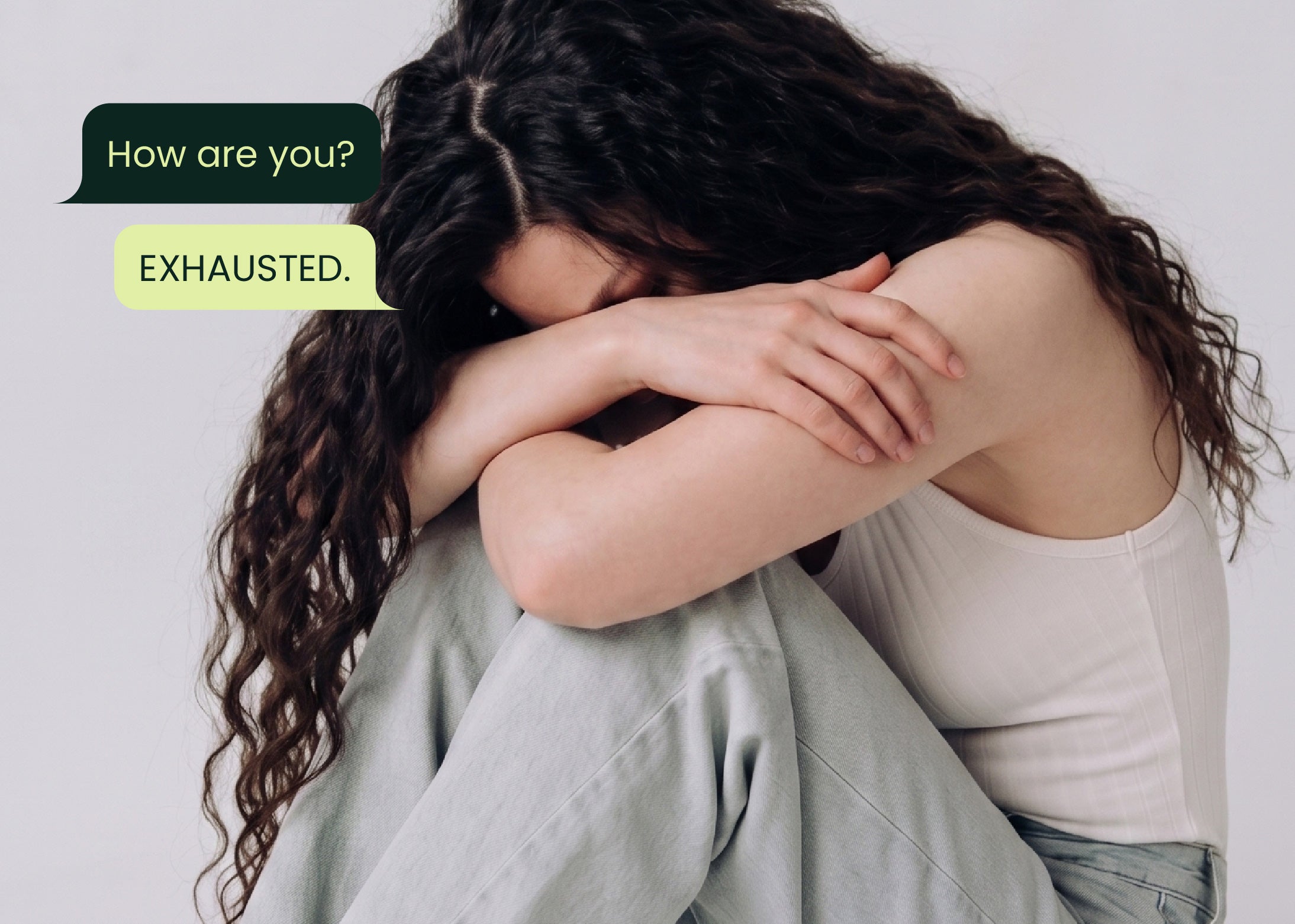
You fall asleep fine. But somewhere between 2am and 4am you are suddenly wide awake, mind running, body tense, and no amount of deep breathing brings you back. You eventually drift off an hour or two later, then the alarm goes off and you feel worse than if you had never slept at all.
Why Your Brain Refuses to Quiet Down
The timing is not random. Your body follows a natural daily schedule, and the hours between 2am and 4am happen to fall during the lightest stages of sleep. That means the brain is closer to the surface during that window, and much easier to pull into full wakefulness than it would be earlier in the night.
What Is Actually Happening Inside Your Brain When This Occurs
Waking at 2am and not being able to get back to sleep is not just bad luck. There is a biological reason it happens, and understanding it makes the whole pattern make sense.
The Loop That Keeps It Going
Everything we have described so far, the cortisol spikes, the blood sugar instability, the drop in GABA, these are all things that chronic stress makes worse. And stress has one more effect that ties everything together: it gradually uses up your body's magnesium reserves over time.³ Scientists call what happens next a vicious circle. When magnesium runs low, the nervous system becomes harder to calm down, which makes stress easier to trigger and harder to shake off. When the nervous system is on edge it becomes harder to stay asleep through the night. And when sleep is poor, the body is less equipped to handle stress the next day, which depletes more magnesium, which makes the nervous system even more reactive. Each part of the cycle makes the next one worse, and over time what started as an occasional bad night can quietly become the new normal.
Why Brain Fog Follows a Bad Night
Brain fog is not just feeling a bit tired. It has a very specific feel to it: thinking takes longer than it should, words are harder to find, you lose your train of thought mid sentence, and tasks that are normally easy suddenly require real effort.
Why These Two Things Are the Same Problem
Here is what ties everything we have talked about together. Cortisol, blood sugar, GABA, and those NMDA receptors in the brain: all four of them are affected by how much magnesium your body has available.
What You Can Actually Do About It
Not everyone is equally affected. Some people are more vulnerable to this pattern than others, and often for specific biological reasons. If you recognize yourself in any of the groups below, that context may help explain why the 2am waking has been so persistent for you.
| Who | Why it happens | What it means for sleep |
| Older adults | The body becomes less efficient at absorbing magnesium as we age, and sleep naturally gets lighter over time⁷ | More time in REM and lighter sleep stages, lower NMDA threshold, and easier to wake from small disturbances |
| Women across reproductive years | Hormonal shifts throughout the monthly cycle affect how much magnesium the body holds on to. Research shows women report poorer sleep quality than men on average⁸ | Lower magnesium means less GABA support and a more reactive nervous system through the night |
| Women in perimenopause and menopause | As estrogen drops, the body has a harder time keeping cortisol under control. Magnesium balance shifts too⁸ | Cortisol spikes become more likely during the night, and the 2am waking pattern becomes much more common during this transition |
| People under chronic stress | Stress burns through magnesium reserves over time, feeding the vicious circle described above³ | A nervous system that stays on edge, with less GABA to keep it quiet and less magnesium to calm those NMDA receptors down |
| Low dietary magnesium | Diets heavy in processed food are naturally low in magnesium, making a shortfall common even in people who eat reasonably well² | Cortisol, blood sugar, GABA, and NMDA regulation all become harder to keep in balance at the same time |
| Heavy or regular alcohol consumption | Alcohol breaks up sleep into lighter, more fragmented stages and depletes magnesium at the same time⁹·¹⁰ | Less deep sleep, more time in lighter stages where cortisol spikes and blood sugar dips can pull you awake |
| Middle-aged men | Research points to middle-aged men as one of the groups most prone to sleep disruption, likely connected to shifts in hormone levels and lifestyle factors² | Higher risk of broken sleep even when there is no obvious reason for it |
The Bottom Line: Your Nervous System Is Telling You Something
Waking at 2am and struggling to think clearly the next day are not two separate problems. They are two signs of the same thing going wrong, just showing up at different times.
The nervous system that cannot stay quiet at night is the same one that cannot focus the next day. They have the same root cause, and when you address that, both tend to improve together.
If what you have read here feels familiar, Neumina Magnesium Complex was built around exactly these mechanisms. Rather than a single form of magnesium, it combines three that each play a different role in the picture we described: helping the nervous system stay calm through the night, supporting your energy levels, and making sure what you take actually gets absorbed. Ashwagandha and Vitamin B6 are included to support the cortisol and GABA sides of the equation, and black pepper extract helps everything work more effectively. It is not a sleep pill. It is a formula designed to give your nervous system what it needs to regulate itself.
Explore Neumina Triple Magnesium Complex & Ashwagandha →
References
-
Yamanaka Y, Motoshima H, Uchida K. Hypothalamic-pituitary-adrenal axis differentially responses to morning and evening psychological stress in healthy subjects. Neuropsychopharmacol Rep. 2019;39(1):41-47. doi:10.1002/npr2.12042
-
He C, Wang B, Chen X, et al. The mechanisms of magnesium in sleep disorders. Nat Sci Sleep. 2025;17:2639-2656. doi:10.2147/NSS.S552646
-
Pickering G, Mazur A, Trousselard M, et al. Magnesium status and stress: the vicious circle concept revisited. Nutrients. 2020;12(12):3672. doi:10.3390/nu12123672
-
Xie L, Kang H, Xu Q, et al. Sleep drives metabolite clearance from the adult brain. Science. 2013;342(6156):373-377. doi:10.1126/science.1241224
-
Ohayon MM, Carskadon MA, Guilleminault C, Vitiello MV. Meta-analysis of quantitative sleep parameters from childhood to old age in healthy individuals: developing normative sleep values across the human lifespan. Sleep. 2004;27(7):1255-1273. doi:10.1093/sleep/27.7.1255
-
Arab A, Rafie N, Amani R, Shirani F. The role of magnesium in sleep health: a systematic review of available literature. Biol Trace Elem Res. 2023;201(1):121-128. doi:10.1007/s12011-022-03162-1
-
Barbagallo M, Veronese N, Dominguez LJ. Magnesium in aging, health and diseases. Nutrients. 2021;13(2):463. doi:10.3390/nu13020463
-
Andersen ML, Hachul H, Ishikura IA, Tufik S. Sleep in women: a narrative review of hormonal influences, sex differences and health implications. Front Sleep. 2023;2:1271827. doi:10.3389/frsle.2023.1271827
-
Vanoni FO, Milani GP, Agostoni C, Treglia G, Faré PB, Camozzi P, Lava SAG, Bianchetti MG, Janett S. Magnesium metabolism in chronic alcohol-use disorder: meta-analysis and systematic review. Nutrients. 2021;13(6):1959. doi:10.3390/nu13061959
-
Koob GF, Colrain IM. Alcohol use disorder and sleep disturbances: a feed-forward allostatic framework. Neuropsychopharmacology. 2020;45(1):141-165. doi:10.1038/s41386-019-0446-0
-
Dagum P, Elbert DL, Giovangrandi L, et al. The glymphatic system clears amyloid beta and tau from brain to plasma in humans. Nat Commun. 2026;17:715. doi:10.1038/s41467-026-68374-8
-
de Sousa Melo SR, dos Santos LR, da Cunha Soares T, et al. Participation of magnesium in the secretion and signaling pathways of insulin: an updated review. Biol Trace Elem Res. 2022;200:3545-3553. doi:10.1007/s12011-021-02966-x
Quick FAQ
Read more
Most people notice the symptoms long before they connect them to the gut. Bloating that lingers after meals. Fatigue that sleep does not fix. Skin that flares without a clear trigger. A sensitivity...

If you have ever stood in the supplement aisle trying to figure out the difference between a probiotic and a prebiotic, you are not alone. The labels are dense, the claims overlap, and nobody seems...
Leave a comment
All comments are moderated before being published.
This site is protected by hCaptcha and the hCaptcha Privacy Policy and Terms of Service apply.