


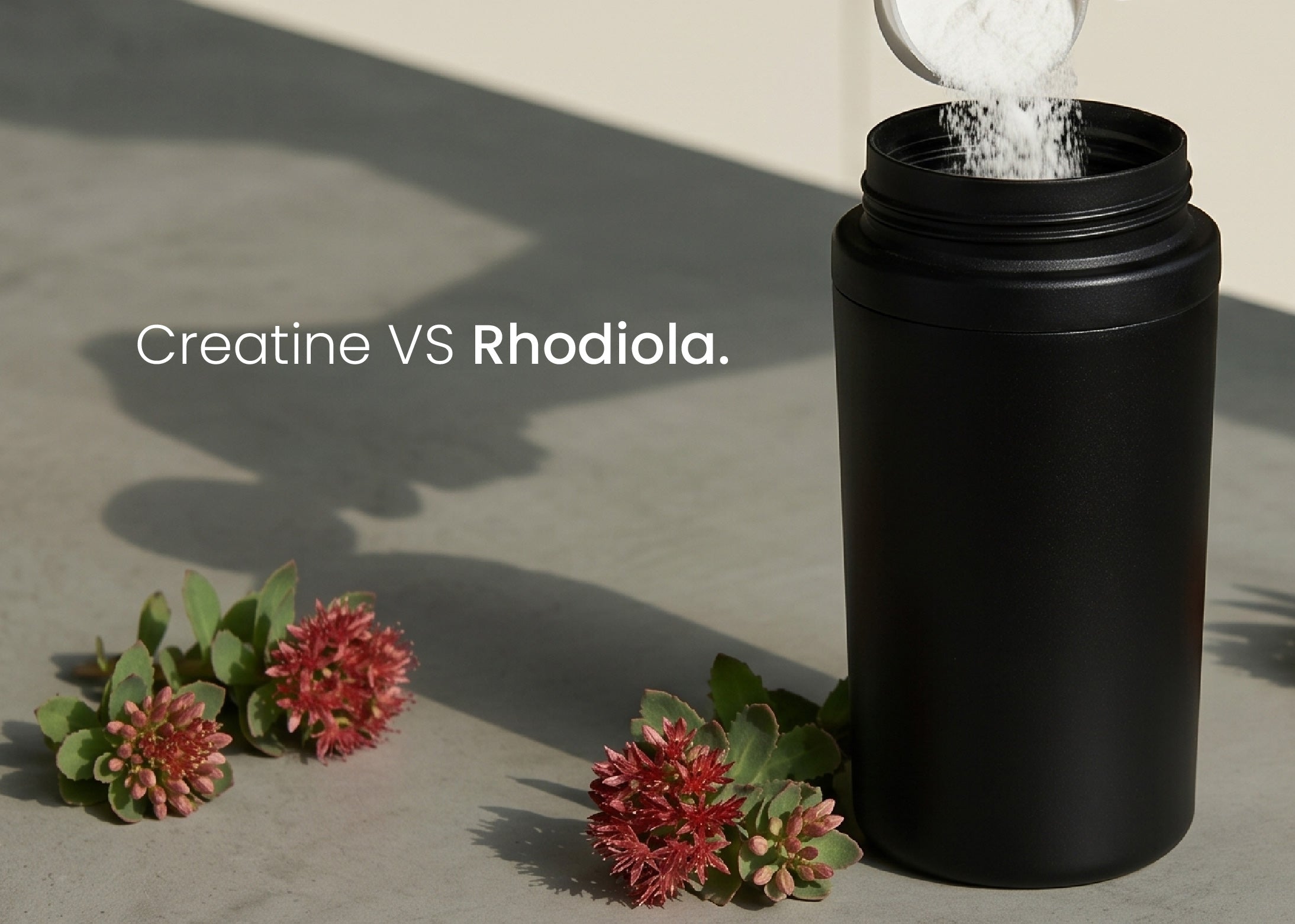
Creatine and Rhodiola: Two Tools, Two Different Jobs
Creatine: the proven staple
Creatine is the most studied performance supplement there is, and one of the few backed by real evidence for what it claims: it helps with quick, powerful movements like a sprint or a heavy lift. The gains are real but modest, and they show up more in some training than others.¹
How it works?
Your muscles run on a fast-burning fuel called ATP. During a hard sprint or a heavy lift, they burn through it fast and have to remake it just as quickly. Creatine is stored in your muscles as phosphocreatine, a quick-release reserve that refills ATP fast.¹ More reserve means quicker refills, which is why creatine helps most with quick, hard bursts.
-
Where it helps most: The clearest gains are in compound lifts like the bench and squat, and in explosive moves like jumps and short sprints. It does less for things like handgrip, and the effect is clearest in younger adults.¹
-
How to take it: Simple: 3 to 5 grams a day of plain creatine monohydrate. You don't need a "loading" phase (a big starting dose to fill up faster) unless you want the effect sooner, and the fancier, pricier forms aren't worth it, no research shows they beat monohydrate.²
Salidroside: the other side of training
Creatine helps you produce force. Salidroside is being studied for something different: helping your body hold up through a hard workout. Same arena, opposite job.
Where it comes from?
Rhodiola's use goes back centuries, valued as a tonic for stress and fatigue. Salidroside is the core of what makes it work, its most potent active ingredient. The catch is that the plant holds very little of it, and rhodiola is slow-growing, high-altitude, and increasingly over-harvested. So extracting pure salidroside is the only way to get a known, consistent dose of the active part, rather than a trace buried in an extract.³
What the research shows?
The key study is an exploratory trial: 50 active adults took pure salidroside (60 mg/day) or a placebo for 16 days, then went through hard exercise. Three things stood out, and all of them are about holding up, not producing more:
-
They used oxygen better during hard intervals.
-
A marker of muscle damage in the blood (myoglobin) rose the day after exercise in the placebo group, but not in the salidroside group, a sign of less muscle damage.
-
On the endurance test, the placebo group dropped off while the salidroside group held steady, in both performance and mood.³
How it works?
Two mechanisms, both studied in the lab rather than in exercising people:
-
An energy switch. In muscle cells, salidroside activates AMPK, the sensor that helps a cell manage its energy when it's running low.⁴ It's the same energy system found in nearly every cell in the body.⁵
-
Handling exercise stress. In animals pushed to exhaustion, salidroside lowered markers of oxidative stress and raised the body's own defensive enzymes, and the animals lasted longer.⁶
Side by Side Comparison
| Creatine | Salidroside | |
| Main job | Fuels short, powerful output during a workout | Helps you recover well and hold up through a hard workout |
| What it does | More force in quick, hard bursts | Better oxygen use, less muscle damage, steadier finish |
| Best for | Lifting, sprinting, explosive power | Coming through hard training with less wear |
| How strong is the evidence? | Rock-solid and settled, decades of research | Early and unfolding, one promising human trial with more research on the way |
| How to take it | 3–5gram a day, monohydrate | Pure compound for a consistent dose |
The Bottom Line
Creatine and salidroside aren't rivals. They're aimed at different parts of the same goal. Creatine helps you push harder when you train. Salidroside is aimed at helping you hold steady as fatigue sets in, and recover with less wear afterward. One raises your ceiling. The other is being studied for helping you get more out of the work you're already doing.
References
-
Kazeminasab F, Kerchi AB, Sharafifard F, et al. The effects of creatine supplementation on upper- and lower-body strength and power: a systematic review and meta-analysis. Nutrients. 2025;17(17):2748. doi:10.3390/nu17172748
-
Antonio J, Candow DG, Forbes SC, et al. Common questions and misconceptions about creatine supplementation: what does the scientific evidence really show? J Int Soc Sports Nutr. 2021;18(1):13. doi:10.1186/s12970-021-00412-w
-
Schwarz NA, Stratton MT, Colquhoun RJ, et al. Salidroside and exercise performance in healthy active young adults - an exploratory, randomized, double-blind, placebo-controlled study. J Int Soc Sports Nutr. 2024;21(1):2433744. doi:10.1080/15502783.2024.2433744
-
Li HB, Ge YK, Zheng XX, Zhang L. Salidroside stimulated glucose uptake in skeletal muscle cells by activating AMP-activated protein kinase. Eur J Pharmacol. 2008;588(2-3):165-169. doi:10.1016/j.ejphar.2008.04.036
-
Hardie DG, Ashford MLJ. AMPK: regulating energy balance at the cellular and whole-body levels. Physiology (Bethesda). 2014;29(2):99-107. doi:10.1152/physiol.00050.2013
-
Xu J, Li Y. Effects of salidroside on exhaustive exercise-induced oxidative stress in rats. Mol Med Rep. 2012;6(5):1195-1198. doi:10.3892/mmr.2012.1060
Quick FAQ
Read more
If you train regularly, you already know the work is the easy part to understand. You show up, you push, you get a little fitter. What's less obvious is everything your body does after. A hard ses...

Adaptogens went mainstream fast. Ashwagandha, ginseng, tulsi, rhodiola, herbs used quietly for centuries, turned up in supermarkets, coffee shops and supplement aisles almost overnight. The idea...
Leave a comment
All comments are moderated before being published.
This site is protected by hCaptcha and the hCaptcha Privacy Policy and Terms of Service apply.