


Ashwagandha: Benefits, Mechanisms, and What the Research Actually Shows
Written by: Jose Guizar Real, MSc
Reviewed by: Yiming (Amy) Qin, PhD, RD
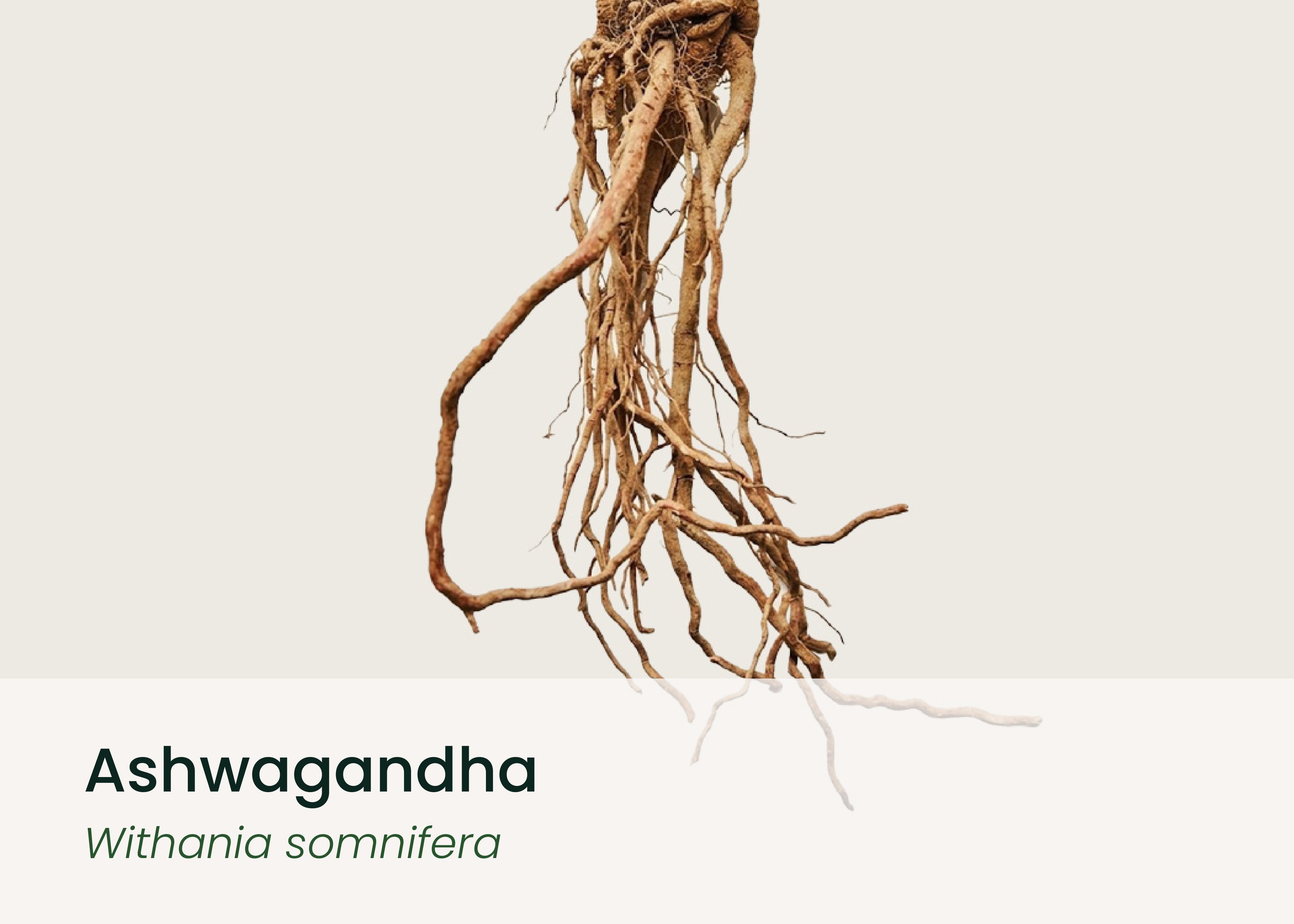
Ashwagandha (Withania somnifera) is a root herb native to India and North Africa, used for centuries in Ayurvedic medicine as an adaptogen, a class of plants studied for their ability to help the body resist physical and psychological stress. It is one of the most researched plant-based supplements available today, and the reputation it has built is backed by a body of clinical evidence that most botanicals cannot match. The reason it keeps showing up in modern supplement conversations is not tradition. It is the consistency of what the research actually shows: measurable reductions in cortisol, real improvements in sleep and stress, and effects on physical performance that hold up across independent trials.¹·¹⁰·¹¹
The active compounds are called withanolides, concentrated in the root, and they appear to work primarily by moderating the body's stress response system, the same system that, when chronically overloaded, quietly disrupts sleep, energy, mood, and recovery.¹ That is the thread this article follows.
How the Stress Response System Works
Most people have felt the difference between stress that sharpens you and stress that grinds you down. The first is useful. The second is the kind that follows you into sleep, sits in your chest for weeks, and makes everything feel heavier than it should. That second kind usually means one thing: your stress response system is not switching off the way it should.
Your body manages stress through a communication loop called the HPA axis, a circuit between the hypothalamus, the pituitary gland, and the adrenal glands.¹·² Under normal conditions, meaning a deadline, a hard conversation, a sudden scare, it fires, does its job, and then settles back down once the moment passes. Under chronic stress that settling never fully happens. Cortisol stays elevated, and over time that affects sleep, energy, mood, immune function, and hormonal balance in ways that build on each other.
Ashwagandha's withanolides appear to act on this system directly, helping moderate cortisol output rather than suppressing it entirely.² A second pathway also plays a role. Ashwagandha interacts with GABA receptors, the part of the nervous system that acts like a volume dial on neural activity, turning down the signal when the brain is running too loud.³ That is the same signaling system targeted by some anti-anxiety medications, which helps explain why ashwagandha's effects on sleep and anxiety tend to show up alongside its effects on stress. The full picture is still being mapped, but the HPA axis and GABA signaling are the two most documented mechanisms.
What Does the Evidence Actually Show
Stress and cortisol
Chronic stress is where ashwagandha has built its reputation, and the evidence holds up under scrutiny. Across multiple independent meta-analyses, cortisol reductions are the most consistent finding in the research.⁶·⁴·⁵ The effects on how stress actually feels tend to be strongest in people already experiencing elevated stress, which is where most of the research was conducted and where the benefits are most meaningful.⁴·⁵ This is not a supplement that manufactures calm from nothing. It works best when there is something to work with.
Sleep
Sleep is where the numbers get interesting. In one randomized controlled trial, people taking ashwagandha reported a 72 percent improvement in sleep quality compared to 29 percent in the placebo group.⁷ That gap is not subtle. Multiple trials confirm improvements in how quickly people fall asleep and how long they stay asleep, with effects most pronounced in people who were already struggling.⁸·⁹ The connection to stress is direct: when cortisol comes down, the nervous system has a better shot at shifting into the recovery mode that sleep requires.
Physical performance
Training breaks tissue down. Recovery is what builds it back up. A nervous system stuck in a stress response does not switch into recovery mode efficiently, which is why people under chronic stress often notice their body takes longer to bounce back than it used to. Studies have found meaningful improvements in strength, power output, and exercise recovery in both trained and untrained adults, with ashwagandha consistently outperforming placebo on measures of strength, cardiorespiratory fitness, and fatigue recovery.¹⁰·¹¹ The picture continues to strengthen with each new trial.
Testosterone
For men who feel like their energy and drive have quietly declined alongside their stress levels, this part of the research is worth knowing about. Some trials have shown statistically significant increases in serum testosterone in adult men, with effects most documented in those with lower baseline levels related to stress or sexual health concerns.¹²·¹⁴ Cortisol and testosterone tend to move in opposite directions: when one is chronically high, the other tends to be suppressed. Lower cortisol creates more room for testosterone to recover, which is why the effects in these trials appear most strongly in men whose hormonal balance was already compromised. This is a targeted benefit rather than a universal one, and it should be understood in that context.
Thyroid function
One randomized controlled trial found that ashwagandha improved thyroid hormone levels in patients with subclinical hypothyroidism, a mild form of underactive thyroid where levels are low but not low enough to cause obvious symptoms.¹³ For people with normal thyroid function, current evidence does not show the same effect.¹⁴ Worth knowing so expectations are set accurately.
| Outcome | Evidence strength | Key finding |
| Cortisol reduction | Strong | Significant reductions across multiple meta-analyses |
| Stress and anxiety | Moderate to strong | Most pronounced in people with elevated baseline stress |
| Sleep quality | Moderate to strong | 72% vs 29% improvement in one RCT; confirmed across multiple trials |
| Physical performance | Moderate to strong | Significant effects on strength, power, and recovery |
| Testosterone | Moderate | Statistically significant increases in men with lower baseline levels; less clear in men without hormonal compromise |
| Thyroid function | Limited | One RCT in subclinical hypothyroidism; no effect in normal thyroid function |
How Much, How Long, and What to Look For
Most clinical trials have used standardized root extracts taken consistently for eight to twelve weeks.¹·⁵ That consistency matters more than most people expect. Taking ashwagandha for two weeks and concluding it does not work is not a fair test of what the evidence actually shows. The dose used across trials varies depending on the extract concentration, which is why withanolide content is a more reliable indicator of what a product delivers than milligrams alone.
The form of ashwagandha in a product makes a real difference. The clinical evidence is built almost entirely on root extracts where the withanolide compounds are most concentrated. Products that clearly identify the extract as root-sourced and declare their standardization on the label are the ones that most closely reflect what the trials actually tested. Leaf extracts and unstandardized products sit outside the evidence base that supports the benefits described in this article.
When evaluating a product, look for four things:
-
Root extract clearly identified on the label, not leaf, not whole plant, and not an unspecified plant part. This matters because the clinical evidence is built almost entirely on root extracts, and leaf or mixed preparations sit outside the evidence base.
-
Declared withanolide content so you know the concentration of the active compounds you are actually getting, not just the total weight of plant material in the capsule.
-
Transparent sourcing and third-party testing, which are the clearest signal that what is on the label matches what is in the product.
-
Dose and standardization aligned: the milligram number on the label only tells part of the story. What matters more is whether the product declares its withanolide content, the active compounds responsible for ashwagandha's effects. A highly concentrated extract at a lower dose can deliver the same active compounds as a larger amount of a less standardized product. If the label does not tell you both the dose and the withanolide percentage, you cannot evaluate what you are actually getting.
Who Gets the Most From It
If you have been running on elevated stress for weeks or months, sleeping poorly, and feeling like your body is not recovering the way it used to, ashwagandha sits at the intersection of exactly those threads. That is not a coincidence. Chronic stress touches nearly every system the body depends on, and ashwagandha's most consistent effects are on the system that coordinates the stress response itself.
The research is clearest for adults already experiencing elevated stress, disrupted sleep, or stress-related fatigue. In people without those starting conditions, the measurable effects tend to be smaller. That does not mean it offers nothing, but it does mean the people who tend to feel it most are the ones who had the most room for the system to come back toward balance.
At standard doses using a standardized root extract, ashwagandha is well tolerated in most adults. Clinical trials using root extracts at standard doses have a reassuring safety record.¹⁵ There have been rare case reports of liver effects associated with commercial products, which is a good reason to prioritize transparent sourcing, declared standardization, and third-party testing when choosing a product. Anyone with existing liver conditions, those who are pregnant or breastfeeding, or anyone taking medications should speak with a healthcare provider before use.
How Ashwagandha Fits the Bigger Picture
Chronic stress does not stay in one lane. It disrupts the gut microbiome, compromises the gut lining, elevates inflammatory signaling, depletes magnesium, and fragments sleep. Most people feel this as a cluster of problems that seem unrelated but share the same upstream cause. Ashwagandha sits at the center of that web because it targets the system doing the coordinating. Supporting the HPA axis does not just affect how stress feels. It affects the conditions every other system in the body is operating under. If you want to understand the full picture, the microbiome article and the magnesium article in this series pick up directly where this one leaves off.
The Bottom Line
Ashwagandha has earned its place in the evidence-based supplement conversation. The research behind it is more substantial than most botanicals can claim, and the effects on stress, cortisol, sleep, and physical performance are consistent across independent research groups.
It works best when there is something to work with. Elevated stress, disrupted sleep, and fatigue are the conditions where the evidence is strongest. At standard doses, with a standardized root extract, taken consistently for at least eight weeks, it delivers on what the research promises.
Frequently Asked Questions
How long does ashwagandha take to work?
Most clinical trials run for eight to twelve weeks, and the evidence suggests consistency over time matters more than dose size.¹·⁵ Some people notice changes in sleep quality and stress response within two to four weeks, but the most reliable effects in the research appear after eight weeks of daily use.
Is ashwagandha safe for long-term use?
Clinical trials using standardized root extracts at standard doses have a reassuring safety record.¹⁵ There have been rare case reports of liver effects associated with commercial products, which underscores the importance of choosing products with transparent sourcing and third-party testing. Anyone with existing liver conditions or taking medications should speak with a healthcare provider before use.
What makes a good ashwagandha supplement?
Look for a product that clearly specifies root extract, not leaf or whole plant, and declares its withanolide content on the label. That second part is the most important: the milligram number alone does not tell you what you are getting. A highly concentrated standardized extract at a lower dose can deliver the same active compounds as a larger amount of a less standardized product. Transparent sourcing and third-party testing are the clearest signal that what is on the label is actually in the capsule.
References
-
NIH Office of Dietary Supplements. Ashwagandha: Is it helpful for stress, anxiety, or sleep? ods.od.nih.gov. Updated 2024. Available at: https://ods.od.nih.gov/factsheets/Ashwagandha-HealthProfessional/
-
Lopresti AL, Smith SJ, Malvi H, Kodgule R. An investigation into the stress-relieving and pharmacological actions of an ashwagandha (Withania somnifera) extract: a randomized, double-blind, placebo-controlled study. Medicine (Baltimore). 2019;98(37):e17186. doi:10.1097/MD.0000000000017186
-
Candelario M, Cuellar E, Reyes-Ruiz JM, et al. Direct evidence for GABAergic activity of Withania somnifera on mammalian ionotropic GABAA and GABAρ receptors. J Ethnopharmacol. 2015;171:264-272. doi:10.1016/j.jep.2015.05.058
-
Akhgarjand C, Asoudeh F, Bagheri A, et al. Does ashwagandha supplementation have a beneficial effect on the management of anxiety and stress? A systematic review and meta-analysis of randomized controlled trials. Phytother Res. 2022;36(11):4115-4124. doi:10.1002/ptr.7598
-
Alsanie SA, Alhodieb FS, Askarpour M. Effects of ashwagandha (Withania somnifera) on mental health in adults: a systematic review and dose-response meta-analysis of randomized controlled trials. Complement Ther Med. 2026;97:103325. doi:10.1016/j.ctim.2026.103325
-
Albalawi AA. Dual impact of ashwagandha: significant cortisol reduction but no effects on perceived stress. Nutr Health. 2025. doi:10.1177/02601060251340449
-
Deshpande A, Irani N, Balkrishnan R, Benny IR. A randomized, double-blind, placebo-controlled study to evaluate the effects of ashwagandha (Withania somnifera) extract on sleep quality in healthy adults. Sleep Med. 2020;72:28-36. doi:10.1016/j.sleep.2020.03.012
-
Langade D, Thakare V, Kanchi S, Kelgane S. Clinical evaluation of the pharmacological impact of ashwagandha root extract on sleep in healthy volunteers and insomnia patients: a double-blind, randomized, parallel-group, placebo-controlled study. J Ethnopharmacol. 2021;264:113276. doi:10.1016/j.jep.2020.113276
-
Cheah KL, Norhayati MN, Husniati Yaacob L, Abdul Rahman R. Effect of ashwagandha (Withania somnifera) extract on sleep: a systematic review and meta-analysis. PLoS One. 2021;16(9):e0257843. doi:10.1371/journal.pone.0257843
-
Bonilla DA, Moreno Y, Gho C, Petro JL, Odriozola-Martinez A, Kreider RB. Effects of ashwagandha (Withania somnifera) on physical performance: systematic review and Bayesian meta-analysis. J Funct Morphol Kinesiol. 2021;6(1):20. doi:10.3390/jfmk6010020
-
Ferreira JF, Ferreira RM, Maia F, Fernandes LG, Leão C, Pimenta N. Biopsychological effects of ashwagandha (Withania somnifera) in athletes and healthy individuals: a systematic review. Muscles. 2025;4(3):24. doi:10.3390/muscles4030024
-
Chauhan S, Srivastava MK, Pathak AK. Effect of standardized root extract of ashwagandha (Withania somnifera) on well-being and sexual performance in adult males: a randomized controlled trial. Health Sci Rep. 2022;5(4):e741. doi:10.1002/hsr2.741
-
Sharma AK, Basu I, Singh S. Efficacy and safety of ashwagandha root extract in subclinical hypothyroid patients: a double-blind, randomized placebo-controlled trial. J Altern Complement Med. 2018;24(3):243-248. doi:10.1089/acm.2017.0183
-
Vollmer G, Brendler T. Evaluation of potential hormonal activities of ashwagandha (Withania somnifera). Phytother Res. 2025 Dec 26 [Epub ahead of print]. PMID: 41454558. doi:10.1002/ptr.70155
-
Williamson EM, Brendler T. Ashwagandha: is it safe? Part 2: a preclinical evidence review. Phytother Res. 2025:1-10. doi:10.1002/ptr.70090
Quick FAQ
Read more
Calcium does much more than build bones—it is the essential mineral that powers your heartbeat, muscle contractions, and nerve signals. But taking calcium alone is not enough. This comprehensive gu...

Not all Akkermansia supplements are created equal. This comprehensive review breaks down three leading products on the market: Neumina, Pendulum, and Codeage. While Pendulum offers a solid single-s...
Leave a comment
All comments are moderated before being published.
This site is protected by hCaptcha and the hCaptcha Privacy Policy and Terms of Service apply.